PEAK CLIMBING REQUIREMENTS
Kyajo Ri is a technical peak, and the requirements are the strictest of all our base camp to base camp climbs. Please read each point before you book:
- Climbing experience: You must be a capable mountaineer. Kyajo Ri is a higher degree of technical peak, and the summit only comes through the effort of both sides: our Sherpas set the camps, fix the ropes and lead, and you bring the skills and fitness to climb them. You should be comfortable climbing steep snow and ice in crampons, ascending fixed rope with a jumar, moving over rock in crampons and abseiling with a figure-8, with previous experience above 5,500 m. A 6,000 m peak such as Island Peak, Lobuche East or Mera Peak helps a great deal, and operators who run this peak suggest alpine routes of PD+ or AD, or Scottish winter climbs of Grade II and III, as preparation.
- Acclimatization before you start: Our service begins at Mende (3,736 m), but you reach Camp II at 5,700 m on Day 5 and the summit on Day 6, so you must arrive well acclimatized. A trek over Gokyo and the Renjo La, Everest Base Camp with Kala Patthar, or a pass trek in the Khumbu are the best preparation. If you need to adjust first, we can arrange the walk-in and extra days (see the packages section below).
- Fitness: You need to walk 6 to 8 hours a day on rough ground and carry your personal gear over moraine, scree and talus between the camps. Summit day takes 10 to 14 hours, so train for 5 to 6 months with loaded hikes, stair climbing and scrambling.
- Group size and fixed departures: Kyajo Ri runs on fixed departures with a minimum of 2 climbers, because a single climber would carry the whole cost of the Sherpa team. We open 2-person fixed departures 1 to 2 years ahead. If a departure does not reach 2 climbers, a supplementary cost may apply, or you can reserve or cancel the trip, or switch to another peak.
- Permits: We arrange the Kyajo Ri climbing permit from the Nepal Mountaineering Association, where the peak is listed in Group A of the trekking peaks. You carry your own Sagarmatha National Park permit and Khumbu Pasang Lhamu Rural Municipality permit (Trek Card), because Mende lies inside the national park.
- Technical gear and personal items: Technical climbing gear is not included in the package cost. However, if you do not have your own equipment, HEN can arrange the required technical gear on rent at an additional cost of USD 150 per climber for the climbing period. The rental set includes a harness set with locking and non-locking carabiners, jumar, figure-8 descender, crampons, ice screws, rock pitons, ice axe and helmet. Climbing boots, sleeping bags and warm mountaineering clothes are personal items that you must bring yourself.
- Guide: You climb with our licensed, English-speaking climbing guide and Sherpa crew from Base Camp upward. On this technical peak the number of climbing Sherpas does not follow a fixed ratio by group size, because your own skills decide how much support you need, and we agree the team with you once we know your experience. You never climb above Base Camp on your own.
- Insurance: You need personal travel and rescue insurance that covers technical climbing up to at least 6,500 m and helicopter evacuation. The insurance we hold for our guide, assistant guides and porters does not cover you.
- Medical fitness: Get a check-up before you travel, especially if you have heart, lung or blood pressure problems, and bring enough of your own prescribed medicine.
- Advance planning and documents: Tell us at least 3 to 4 days ahead, even if you are already somewhere in the Everest region, because the permit is processed from Kathmandu. Keep a copy of your passport, a passport-size photo and a copy of your insurance ready to send by email or WhatsApp. Saturday is a government holiday in Nepal, so permit work happens on the other days.
PEAK CLIMBING HIGHLIGHTS
- Stand on the pointed summit of Kyajo Ri (6,186 m), the highest peak on the southern end of the ridge between the Thame and Gokyo valleys.
- Walk into the Kyajo Drangka, a hidden valley beneath Khumbila, and sleep at a meadow Base Camp (4,550 m) that few climbers share.
- Sleep at 3 camps above Mende: Base Camp, Camp I (5,200 m) beside a glacial lake, and Camp II (5,700 m) on a snowy col.
- Rehearse jumar changeovers, abseiling and crampon work on rock at Base Camp using your own or rented technical climbing equipment.
- Cross an easy-angled glacier, then climb a steep snow couloir of 45 to 50 degrees by front-pointing.
- Climb the rock band on fixed rope, 1 climber at a time, with your crampons scraping over small holds.
- Follow an S-curve of 50 to 55 degree snow and ice, with short pitches reaching about 65 degrees near the top.
- Cross the narrow, exposed final snow ridge to the summit, with Everest, Lhotse, Makalu and Cho Oyu, 4 of the 6 highest mountains on Earth, around you.
- Use the flexible day at Camp I as acclimatization and weather insurance.
- Climb with qualified Sherpa guides who have summited Everest or climbed above 7,500 m.
PEAK CLIMBING PLAN
The climb moves in 3 stages: the walk into Base Camp, the 2 camps above it, and the summit push from Camp II.
- Day 1: Meet our guide at Mende (3,736 m), visit Lawudo Gompa and trek about 7 hours to Kyajo Ri Base Camp (4,550 m).
- Day 2: Acclimatize at Base Camp and rehearse jumar, abseil and rock-crampon skills on fixed rope.
- Day 3: Climb the gully, the lakeside traverse and the loose scree slope to Camp I (5,200 m).
- Day 4: Rest and acclimatize at Camp I, or move up early if the weather and your body allow it.
- Day 5: Cross the glacier, climb the gully and the 45 to 50 degree snow couloir to Camp II (5,700 m).
- Day 6: Start after midnight, climb the rock band and the S-curve to the summit (6,186 m) and descend to Camp II.
- Day 7: Descend through Camp I to Kyajo Ri Base Camp.
Your guide checks your boots, crampons, harness, helmet and layers at Base Camp, again at Camp I and again at Camp II. Summit day starts after midnight by headlamp.
Before leaving Camp II, the guide sets a turnaround time and keeps to it. If you are too slow, the weather turns or the snow is unsafe, the guide turns the team around, because on a peak with exposed ground the descent is the part that cannot be rushed.
Camp I and Camp II are the minimum camps on this climb. If conditions or the team's pace make it necessary, the team may have to build up to Camp III, which adds days to the 7-day plan!
Essential High-Altitude Gear and Safety Notice
For a successful Kyajo Ri climb, you need the right high-altitude and technical equipment. With tented nights at 4,550 m, 5,200 m and 5,700 m and a summit at 6,186 m, these items decide how warm, safe and strong you feel on summit day.
- Insulated Mountaineering Boots: You need single or double insulated boots that fit crampons, for the rock band, the couloir, the glacier and the summit ridge. They are a personal item, so bring boots you have already worn on long days.
- Crampons: Crampons go on at Camp I and are used on snow, ice and rock. They are part of the technical gear set that we arrange on rent, and our guide checks the fit with you at Base Camp.
- Ice Axe: Your ice axe gives you balance and security on the couloir and the S-curve. It is part of the rented technical set, and we show you how to use it.
- Four-Season Sleeping Bag (-25°C or below): Camp II sits on an exposed col, and poor sleep at 5,700 m can weaken your summit push. This is a personal item.
- Down Jacket and Windproof Outer Shell: Both protect you during the midnight start and when the wind rises. Bring your own warm mountaineering clothes.
- Gloves: Bring thin gloves with enough dexterity for the jumar and carabiners, together with warm insulated mittens for the cold hours of the climb.
- Climbing Helmet: A helmet is needed from the gullies upward, because loose rock and falling ice are real hazards. It is part of the rented technical set.
- Harness and Ascender (Jumar): You use a harness set with locking and non-locking carabiners and a jumar on the fixed ropes of the rock band and the upper slopes. Both are part of the rented technical set, and we train you at Base Camp before we move up.
- Technical Climbing Equipment: HEN provides the fixed rope and main rope for the route as part of the package. The personal technical set (harness set, jumar, figure-8 descender, crampons, ice screws, rock pitons, ice axe and helmet) is arranged on rent at USD 150 per climber.
- Supplemental Oxygen: Not required at 6,186 m. Acclimatization, steady pacing and a guide who watches your oxygen saturation and symptoms matter far more than extra equipment.
Peak Climbing Packages: Choose What Works Best for You
This is a base camp to summit to base camp package. It covers the technical part only: the walk from Mende to Base Camp, 2 camps above it (up to Camp III if conditions require), the summit climb and the return to Base Camp, with our climbing guide and Sherpa crew, camp logistics, food and tented accommodation, the peak permit and the fixed ropes.
Personal technical climbing equipment is not included in the package price. You can bring your own equipment or rent the complete technical gear set through HEN for an additional USD 150 per climber!
- Option A: Base Camp to Base Camp (this package): It is our most flexible peak climbing option, made for trekkers and climbers who finish a personal trip in the Khumbu and want to add a technical summit, individually or in a group, as long as they are already well acclimatized.
- Option B: Full Kyajo Ri climbing from Kathmandu: If you want one team for everything, we arrange the same Kyajo Ri climb from your arrival in Kathmandu and take care of the entire logistics: airport transfers, hotels, flights to Lukla, the acclimatization trek and the climb. This is our 17-day Kyajo Ri Peak Climbing package, and it is also the better choice if you need extra time to adjust.
This package does not replace our full-package peak climbing pages, which remain valid. If you would rather have a longer, slower build-up, those pages are still there for you!
What This 7-Day Kyajo Ri Peak Climbing Is About
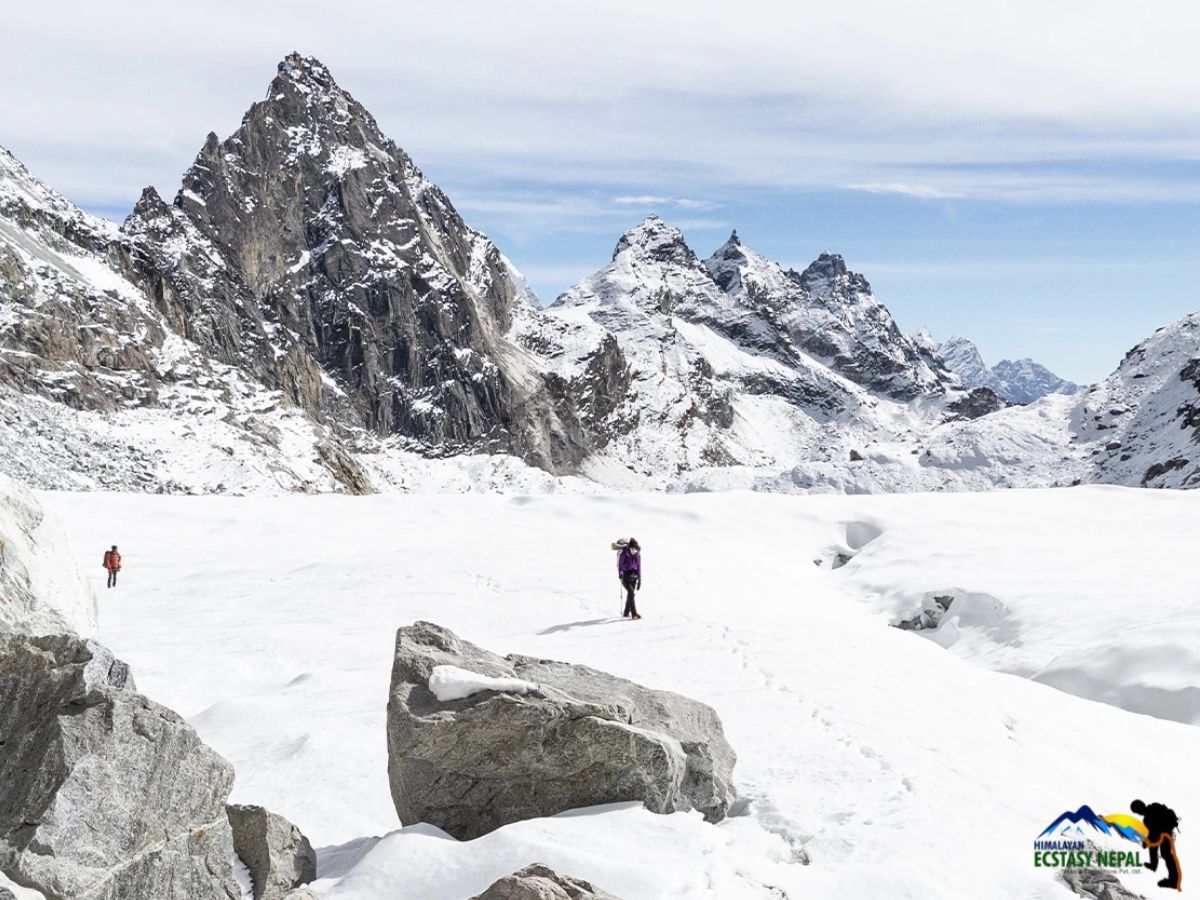
Most 6,000 m peaks in the Khumbu make one promise: walk steadily, clip into a single steep slope, and you are on top!
Kyajo Ri makes a different one. It promises a hidden valley with almost nobody in it, 2 camps above Base Camp, a rock band climbed one rope at a time, and a pointed snow summit with drops on both sides. It keeps that promise!
Our 7-day package is the base camp to summit to base camp way to climb it. We meet you at Mende (3,736 m), walk you into the Kyajo Drangka valley, and take you up through Base Camp (4,550 m), Camp I (5,200 m) and Camp II (5,700 m) to the summit at 6,186 m and back down to Base Camp.
The mountain side is ours: Sherpa guides, fixed ropes, tents, camp kitchen and permit, with the technical gear available on rent. You bring the experience, the acclimatization and the nerve!
If you have climbed Island Peak, Lobuche East or Mera Peak and wondered what comes next, this is a very good answer!
A Trekking Peak on Paper, an Expedition Peak on the Mountain
The Nepal Mountaineering Association lists Kyajo Ri as a Group A trekking peak, which means a simpler and cheaper permit than an expedition peak!
The label says nothing about the climbing. Our experienced HEN team that has led this peak climb multiple times still calls it a "full-blown expedition peak" that is steeper and more sustained than Island Peak or Lobuche East!
Moreover, the summit day is comparable to Ama Dablam and significantly harder than Island Peak or Lobuche East. Here is how the peaks compare:
| Factors | Mera Peak | Island Peak | Lobuche East | Kyajo Ri |
|---|
| Height | 6,476 m | 6,189 m | 6,119 m | 6,186 m |
| Typical Alpine grade | F, final slope PD | PD+ | PD+ | AD |
| Steepest ground | About 40 to 50 degrees, short | 45 to 60 degrees, headwall | About 45 to 50 degrees, headwall | 50 to 55 degrees, short pitches to about 65 |
| Camps above Base Camp | High Camp | None | High Camp | Camp I and Camp II |
| Rock climbing | None | Rocky gully | Rock scramble | Rock band on fixed rope |
Why Kyajo Ri Is Not a Solo, Alpine-Style Peak?
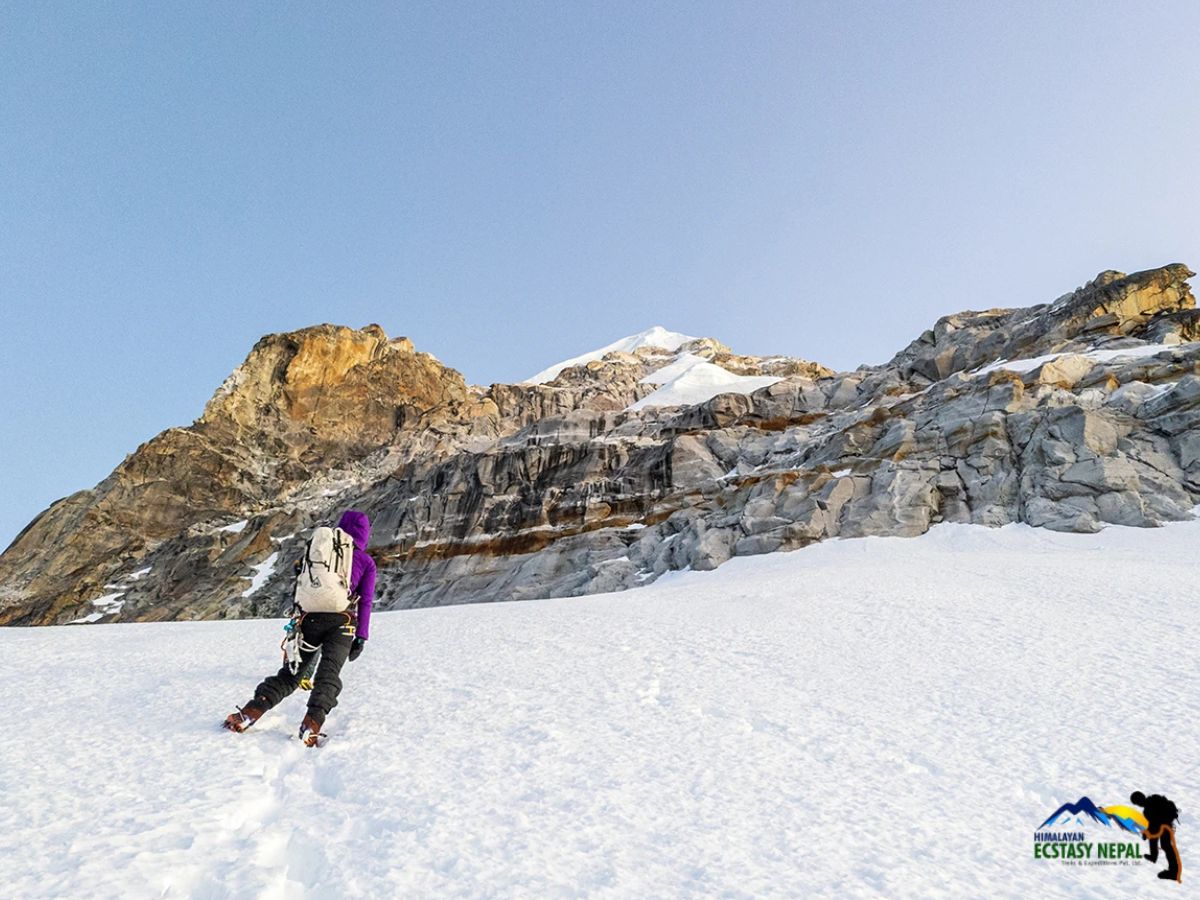
Some strong climbers in Europe and elsewhere climb peaks like this alpine style, light and fast and without fixed ropes. In Nepal, that is rare, and our CEO, Sujan Bhattarai, is clear that Kyajo Ri is not a solo alpine mountain.
Nepal's terrain is more vertical and carries more exposure than most European ranges, so the culture of alpine-style solo climbing is small here, and Nepali climbers are not used to working that way.
On Kyajo Ri, we climb as a roped, Sherpa-supported team, and we treat Kyajo Ri and Cholatse as peaks of the same category, almost an Ama Dablam style expedition.
That also explains the cost and the gear arrangements! A peak in this category needs a higher peak allowance, a better paid, better insured climbing Sherpa, and far fewer climbers reach its summit than on a normal trekking peak, so it cannot be run like Island Peak. It is also why the technical gear is arranged on rent rather than included!
A Brief History of Kyajo Ri: The Mountain Opened in 2002
Nepal opened Kyajo Ri to climbers in 2002, and Duncan Wilson and Vincent Marche made the first official ascent on 20 October 2002 by the Southwest Ridge, approaching from Machhermo across the Kyajo Glacier.
French and Dutch teams repeated the route in 2003, and an American team climbed the Southeast Ridge in 2005. Cosley and Houston found rusted cans and rock tent platforms at their high camp, so someone may have visited before the official opening.
In 2006, they explored the approach from the south through the Kyajo Drangka and climbed the Southwest Ridge with every team member reaching the summit, which is the approach we follow today!
The Mountain in Seven Chapters
The best way to understand Kyajo Ri is to read it as the sequence of terrain you will actually move through.
- Chapter 1: The Hidden Valley: From Mende, the trail climbs steeply above the canyon of the Thesebu Khola, then follows a faint yak track over a couple of passes into the Kyajo Drangka. Base Camp (4,550 m) is a flat meadow surrounded by rock walls, quiet and remote, but the sun leaves it early in the afternoon, so evenings turn cold quickly.
- Chapter 2: The Gully and the Lake: Leaving the valley, the route climbs a long gully, then traverses upward to the edge of a lake in a second hanging valley. A final slope of loose scree, around 150 m, leads to the ledges of Camp I (5,200 m) beside a glacial lake. Leaders who have climbed here describe the gullies as long, loose and tiring, with more effort than technique.
- Chapter 3: The Glacier and the Col: From Camp I you cross an easy-angled glacier in crampons, climb a bigger gully of scree and boulders, and reach a steepening snow couloir of 45 to 50 degrees that needs front-pointing. It ends on a snowy col, where Camp II (5,700 m) sits as a small, exposed platform.
- Chapter 4: The Rock Band: Summit day starts after midnight. A short snow ramp leads to the foot of the rock band, where the fixed rope begins. Only 1 climber can move on each steep section, crampons scrape over small holds and the jumar does the pulling. Climbers often say that getting established on the wall is the hardest part.
- Chapter 5: The S-Curve: Above the rock, the route winds through an S-curve of steep snow and ice, at 50 to 55 degrees, bypassing steeper rock and ice on either side. The full climb involves about 12 pitches, and one or two near the top reach roughly 65 degrees.
- Chapter 6: The Wedge: The final snow ridge, around 100 m long, is narrow and exposed, with long drops on both sides. It ends at a tiny, pointed summit, where Everest, Lhotse, Makalu and Cho Oyu, 4 of the 6 highest mountains on Earth, stand around you.
- Chapter 7: The Way Down: The descent is as demanding as the climb. You down-climb the easier ground, rappel the steep sections on the fixed anchors and move one at a time through loose terrain, where rockfall can start with a single stone. Summit day can last 10 to 14 hours, and tired climbers must stay as careful on the way down as on the way up.
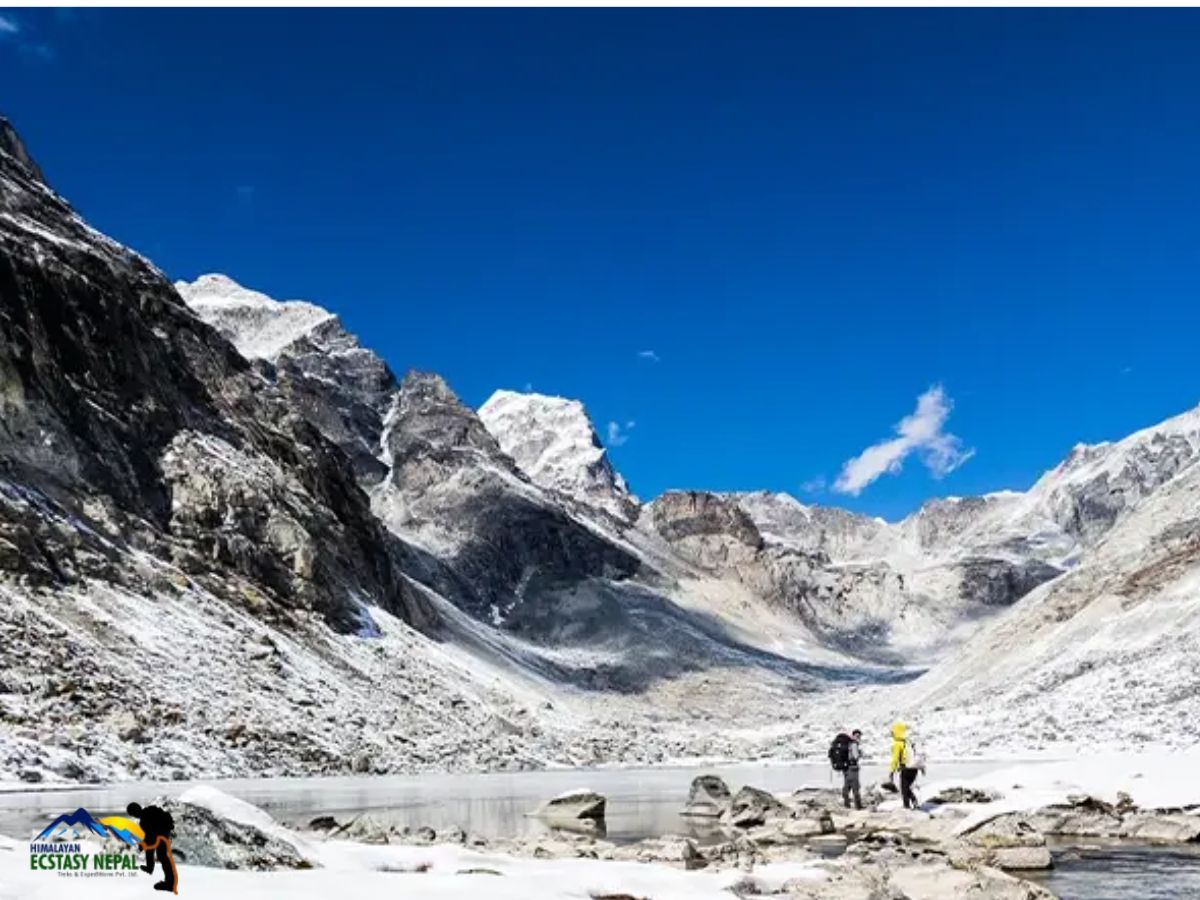
How We Keep 7 Days Honest?
Our base camp to summit base camp format takes 4 to 5 days on Island Peak, Lobuche Peak and Mera Peak, and that figure applies only to those 3 peaks. Other peaks need 6 to 7 days depending on category and technique, and Kyajo Ri is one of them!
The time on any mountain depends on elevation, technical difficulty, the distance of the summit push, the route and how much fixed line has to be set, and on Kyajo Ri every one of those points to a longer plan: 2 camps above Base Camp, a rock band and a long summit day.
Day 4 is deliberately flexible. If the forecast is good and everyone is eating and sleeping well, the guide can move the team up to Camp II a day early, which leaves a spare day at the end for a second summit attempt. If not, the team rests at Camp I and keeps to the plan.
Camp I and Camp II are the minimum camps for this plan, and when necessary the team may have to build up to Camp III, which adds days to the programme. Our Sherpas decide this with the guide on the mountain, based on the snow, the weather and how the team is moving.
Who This Package Is For, and Who Should Wait?
Kyajo Ri suits well-skilled mountaineers who are already well acclimatized and have climbed at altitude before!
It is a step up from normal trekking peaks, so the summit depends on effort from both sides: our Sherpas set camps, fix ropes and lead, and you bring the technical skills and the fitness to climb them. It is a natural next step for a climber who has finished a two pass trek, a three pass trek or Everest Base Camp (any one), has stood on a 6,000 m peak and now wants something steeper and more meaningful!
Teams and groups are always welcome, and even though the climbing is challenging, we keep the programme flexible.
If you have never used crampons on steep ground, start with our 4-day Island Peak climb and come back to Kyajo Ri when you are ready. We would rather see you succeed on the right mountain than struggle on the wrong one!
Built From the Ground Up: How This Package Came About
We designed this short format ourselves, from the grassroots and from long experience. When we asked what our clients wanted, most gave the same answer: light arrangements and base camp to base camp support.
We have offered that from early on, and we have operated the popular peaks ourselves! Kyajo Ri takes the same idea to a more technical mountain, with the same promise of quick, feasible, cost-price programmes and quality service, and with the challenge saved for the mountain itself.
It is an additional option, and our full package remains valid for climbers who prefer it. Some other operators still follow the same approach, keep their margins small and understand safety and quality service. We say so openly because social media has left many travellers unsure about who to go with and where.
What We Provide on the Mountain?
The package covers the climbing logistics: the Kyajo Ri climbing permit, fixed rope and main rope for the route, dome tents with mattresses (twin sharing) at Base Camp, Camp I and Camp II, a kitchen and dining tent, kitchen equipment, a toilet tent at Base Camp, meals as shown in the itinerary and a comprehensive medical kit with an oximeter.
Your climbing guide is English-speaking, professional, experienced and licensed, and porters carry the climbing items according to the porter ratio. The guide, assistant guides and porters are insured as Nepal government rules require.
Here are some important things to note:
- Technical gear rental: Personal technical climbing equipment is not included in the package. Climbers who do not have their own equipment can rent the required gear through HEN for USD 150 per climber for the climbing period. The rental set includes a harness set with locking and non-locking carabiners, jumar, figure-8 descender, crampons, ice screws, rock pitons, ice axe and helmet. Climbing boots, sleeping bags and warm mountaineering clothes are personal items and must be brought by each climber.
- Climbing Sherpa ratio: On a normal peak, the number of climbing staff follows the group size. On a higher-degree technical peak like Kyajo Ri, it does not, because the participant must be a well-skilled mountaineer, and the summit comes only through the effort of both sides, you and your Sherpas. Without that, even 2 lead climbers may not be enough. So we agree the team with you once we know your experience, rather than promise a fixed ratio.
- Additional climbing Sherpa: If you want 1 or more additional climbing Sherpas, the cost is USD 550 per Sherpa, higher than on a normal peak because Kyajo Ri needs a higher peak allowance. Private support staff are also available on request (additional charges apply).
How Booking Works and a Scam You Should Know About
Start with a message to our head office on WhatsApp or by official email, so that you receive authentic, official documentation. All paperwork is processed from Kathmandu, and once your climbing permit is issued you are eligible to start climbing!
Give us at least 3 to 4 days of notice, even if you are already in the Everest region, so that we can arrange the permit and logistics. Saturday is a government holiday in Nepal, so permits are handled on the other days.
Be ready for instant payment, and send a copy of your passport, a passport-size photo and a copy of your insurance through the official email or WhatsApp.
Scam warning: Someone has already taken bookings by claiming to be HEN staff, and some of those customers later came to our real office. Please contact only our head office through WhatsApp or the official email, even when you want to pay instantly, and make all payments and bookings only through the head office!
Climbing Clinic for Those Who Want to Learn First
If you have time before the climb, we run a climbing clinic for people who want to learn climbing and its methodology in a formal way, which is a smart step before a technical peak like this one!
Sign up at least 1 month in advance, so that we can fix a mountaineering instructor for you. We have given this programme special priority since the company began, and climbers who trusted us were fully satisfied and recommended it often.
The itinerary, programme and curriculum are coming soon, and we will brief you personally when you ask.
Safety Comes Before Price
The price on our website works because it is quoted on the real number of participants, which keeps it feasible and effective for each group. Even so, please do not decide on price alone!
As our CEO puts it, think twice, because safety matters more than price, and an experienced climbing guide will make you feel that during the summit attempt. On a peak with rockfall, fixed ropes and exposed ridges, that experience is what you are really buying.
Our climbing guides are qualified guides who have summited Everest or climbed above 7,000 and 8,000 meter mountains. If a team member falls sick, we always bring that person down to a safe place to rest while the others continue the summit push.
Why Climb With Himalayan Ecstasy Nepal?
On a fixed rope at 6,000 m, with a drop on each side, the people around you matter more than anything printed in a brochure. This is what we put behind the 7-day climb:
- Guides who have been higher: Every climbing guide is qualified and has summited Everest or climbed above 7,500 m, and safety comes first in how they work.
- A rehearsal before the real thing: On Day 2, the guide runs jumar, changeover, abseil and rock-crampon drills at Base Camp with your rented gear, so the rock band is not your first attempt.
- Ropes, anchors and permit sorted: Fixed rope, main rope, tents, the camp kitchen and the permit are ours to arrange, and the technical gear is available on rent, so you do not have to buy it or carry it from home.
- Honest about the level: We tell you plainly that this is an almost expedition-level climb and that your skills matter, so you arrive prepared rather than surprised.
- A flexible day at Camp I: Day 4 gives your body time to adapt and gives the weather room to change its mind.
- Your choice of how to join: Join a 2-person fixed departure, bring a private group, or add a climbing Sherpa or support staff.
- A legacy behind the format: We have offered base camp to base camp support from early on, and this programme grew from what climbers asked us for.
- A real office in Kathmandu: Documentation, permits and payments go through our head office, so you always know who is operating your climb and who your team will be.
A hidden valley, 2 high camps, one rock band and a 6,186 m summit, with a team that knows the route. Hurry up, reserve your seat, and book now!