The Annapurna Circuit with Tilicho Lake offers a mix of adventure, stunning high-altitude landscapes, and cultural immersion. While the main Annapurna Circuit can see crowds in peak season, this extended route remains less-traveled. Trekking involves high mountain passes, river valleys, and alpine terrain, with optional guided or independent support. Located in Nepal’s Annapurna region (Latitude: 28.5828° N, Longitude: 83.8353° E), this trek is perfect for those seeking a remote experience, authentic villages, and the dramatic beauty of Tilicho Lake and surrounding peaks.
Annapurna Circuit with Tilicho Lake Trek in 16 Days
Trip Overview
Duration16 Days
Trip GradeModerate
CountryNepal
Maximum Altitude5,416 m
Group Size1 - 20 pax.
StartsKathmandu
EndsKathmandu
ActivitiesTrekking
Best TimeMarch - May, October - November
TREK HIGHLIGHTS
- Walk through the classic Annapurna Circuit with a special side trip to Tilicho Lake, one of the highest lakes in the world.
- Enjoy wide mountain views of Annapurna I, II, III, Pisang Peak, and the Tilicho range throughout the trek.
- Cross the famous Thorong La Pass, one of the highest trekking passes in Nepal, at 5,416 meters.
- Experience local mountain life in villages like Manang and Muktinath, with strong Buddhist and Himalayan culture.
- Walk through different landscapes from green forests and rivers to dry valleys and high alpine terrain.
- Enjoy a mix of comfortable teahouse stays and simple mountain lodges along the route.
- Fully organized trek with experienced guides and all permits managed by Himalayan Ecstasy Nepal.
Annapurna Circuit with Tilicho Lake Trek is much better than the general Annapurna Circuit Trek. It’s a journey where you slowly move from busy city life into quiet, high Himalayan landscapes. The trek can be completed in 16–17 days depending on pace and optional stops, giving you a flexible and comfortable experience.
From the first day, you start seeing rivers, villages, and mountain views. As you go higher, everything changes: the air, the terrain, and even the way you feel. The highlight of this trek is reaching Tilicho Lake and crossing Thorong La Pass. These are moments you will remember for a long time.
This trek gives you a complete experience of Nepal in one journey. You don’t just follow the main trail. You also take a special route to Tilicho Lake, which many trekkers miss. This adds something unique to your trip.
You will walk through different landscapes every day: green forests, river valleys, dry high-altitude deserts, and snowy mountain areas. It never feels the same. You also get to experience local culture, especially in places like Manang and Muktinath. Small villages, monasteries, and simple mountain life make the journey more meaningful.
And of course, crossing Thorong La Pass gives you a real sense of achievement. It is challenging, but very rewarding.
We don’t just guide you, we travel with you. Our team knows these trails very well. We understand the weather, altitude, and real ground conditions. That means we don’t just follow a fixed plan. We adjust based on how you are feeling.
Your safety and comfort always come first. From permits to daily planning, everything is managed properly, so you don’t have to worry. We keep things simple, clear, and honest, just like this trek should feel.
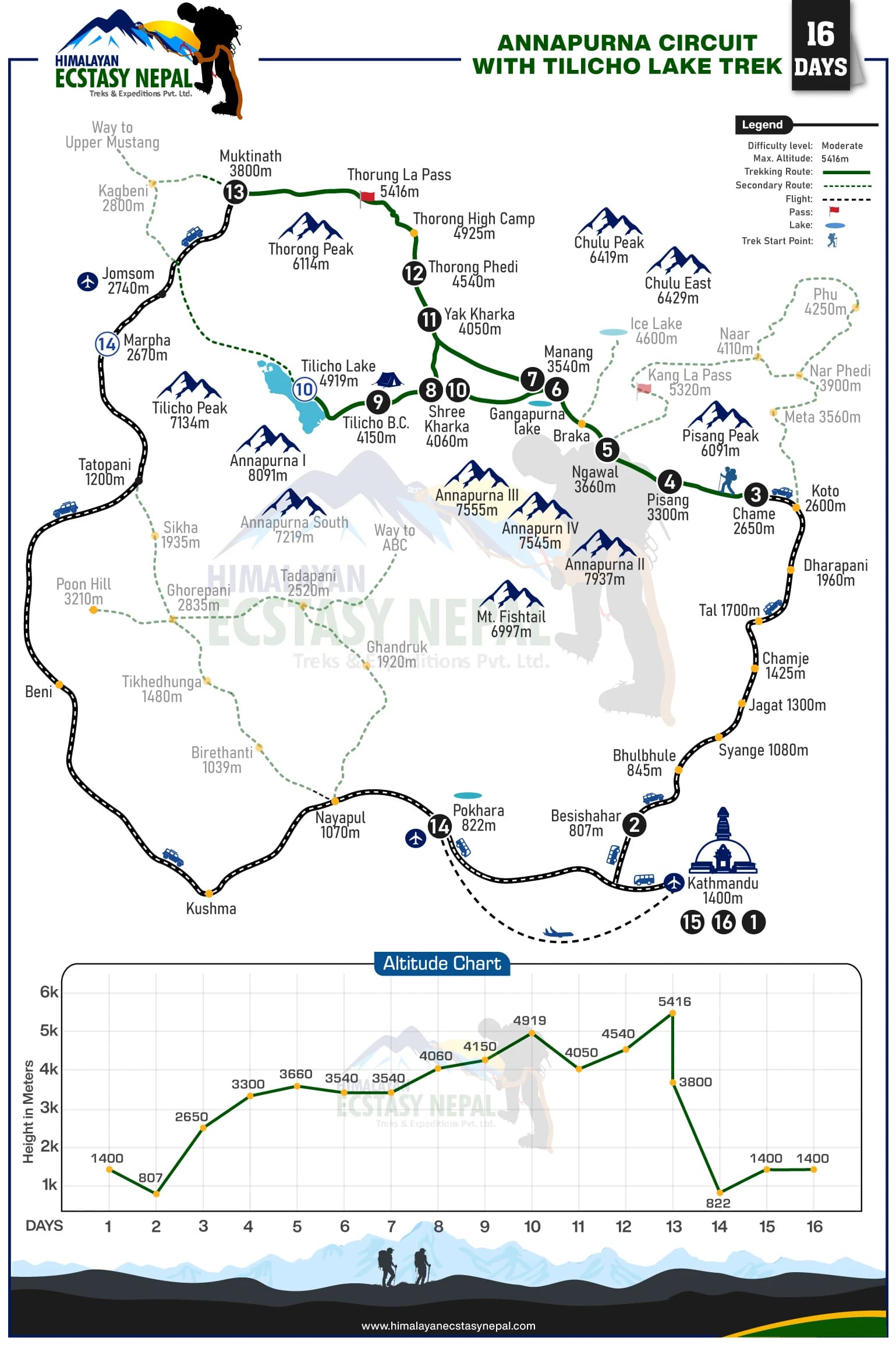
Your journey starts from Kathmandu, followed by a drive to Besisahar and then up to Chame. From here, you begin trekking through forests and mountain villages towards Pisang, Nawal, and Manang, where you take time to acclimatize.
We include an extra day in Manang to rest and properly acclimatize, which helps prevent altitude sickness and gives you more time to explore this beautiful village.
After Manang, you move towards the Tilicho side, trekking to Shri Kharka and Tilicho Base Camp, and then hike up to Tilicho Lake before returning to the main trail.
You continue towards Yak Kharka and Thorong Phedi, preparing for the biggest day, crossing Thorong La Pass. After the pass, you descend to Muktinath and then drive to Pokhara. You also have flexible options for your return: private or shared jeep to Pokhara, or an additional flight from Jomsom for an extra cost.
If time allows, there’s an optional stay in Marpha, a culturally significant village since 1400-1600 BC in the Thak Khola region. Here, you can explore traditional architecture, monasteries, chortens, and sample famous Thakali cuisine, which is going to be a memorable addition for those who want a richer cultural experience.
Finally, you return to Kathmandu, completing a full Himalayan journey with both adventure and variety.
Is Annapurna Circuit with Tilicho Trek Right for You?
This trek is a great choice if you:
- Enjoy high-altitude trekking and mountain views
- Want to visit Tilicho Lake along with the main Annapurna route
- Are comfortable walking 5-7 hours a day
- Can adjust to basic teahouse accommodation in higher areas
This trek is especially good for:
- Adventure lovers
- First-time high-altitude trekkers with good fitness
- Travelers who want both a popular trail + unique side trip
If you prefer more comfort, we can easily adjust the trip for you:
- Add porter support so you carry less
- Upgrade stays in bigger villages
- Arrange private transport and a flexible itinerary
- We always try to match the trek based on your comfort and travel style.
Why Choose Himalayan Ecstasy Nepal (HEN) for This Trek?
Well, we don’t just guide you, we travel with you. Our HEN team knows the trail, weather, and real ground conditions. We plan each day based on your pace, not just the itinerary.
From permits to safety, everything is handled properly so you can focus on enjoying the journey!
Walk Into the Heart of the Annapurna Region
As you begin this journey, you slowly leave behind the busy city life and move into the mountains of the Annapurna region.
You don’t just see the change, you feel it. The air becomes fresher, the surroundings quieter, and everything feels more peaceful.
From rivers and forests to high mountain valleys, every day brings something new. This gradual transition makes the trek very enjoyable and helps your body adjust naturally.
The Magic of Tilicho Lake: A Hidden Himalayan Gem
One of the biggest highlights of this trek is reaching Tilicho Lake. This lake sits high in the mountains and feels very calm and untouched. When you reach here, everything becomes quiet. The water reflects the surrounding peaks, and the whole place feels unreal.
It’s not just about reaching the lake; it’s about the journey to get there. The trail is more remote, less crowded, and gives you a deeper mountain experience.
Crossing Thorong La Pass: A Moment of Pride
Crossing Thorong La Pass is one of the most exciting parts of the trek. It is a long and challenging day, but once you reach the top, the feeling is completely different. You will see wide mountain views all around you.
This is the moment when many trekkers feel proud of themselves. It’s not just a physical achievement, but also a mental one.
The Beautiful Manang Village: Where Mountains Meet Culture
Manang is more than just a stop on the trek. It’s a place where you slow down and connect with the mountains. You can see monasteries, prayer flags, and local life all around. The culture here has a strong Tibetan influence, which makes it very unique.
This is also where you take time to rest and adjust to the altitude. You can explore nearby viewpoints, walk around the village, or simply enjoy the peaceful environment.
Changing Landscapes That Keep You Inspired
One of the best parts of this trek is how much the scenery changes. You start with green forests and rivers, then move into dry, open valleys, and finally reach high alpine terrain with snow and rocks.
It never feels repetitive. Every day looks different, and that keeps the journey interesting from start to finish.
Simple Mountain Life and Local Experiences
During the trek, you stay in small lodges run by local families. You get to eat simple food, sit around warm dining areas, and share stories with other trekkers. These small moments often become your best memories.
Places like Muktinath also give you a chance to see how culture and religion are deeply connected in mountain life.
Annapurna Circuit with Tilicho Lake Trek in 16 Days Itinerary
Kathmandu to KathmanduExpand all
You arrive in Kathmandu, and our HEN team will be there to welcome you at the airport. We transfer you to your hotel in Thamel. After a long flight, today is for rest. You can relax, take a short walk, or just enjoy the atmosphere around Thamel.
In the evening, we will meet you for a short briefing. We explain the journey and help you prepare for the trek.
Today, your journey starts. You drive to Besisahar. The road is mostly smooth at first, then becomes a bit bumpy. We stop along the way for tea, snacks, and short breaks.
You will see rivers, farms, small towns, and local life. It’s a nice introduction before heading into the mountains. By evening, you reach Besisahar and rest.
After breakfast, you continue by jeep to Chame. The road is rough, but the drive is very scenic. You pass waterfalls, forests, and deep river valleys.
As you go higher, the air feels cooler and fresher. By the time you reach Chame, you’ll feel like you are already in the mountains.
Today is your first trekking day. You walk through beautiful pine forests with fresh air and peaceful surroundings. Along the way, you may see yaks and mule caravans carrying goods.
You also get great views of Pisang Peak and the Annapurna range.
Today, you take the upper route via Gheru, which is more scenic. The trail starts easily along the valley, then climbs up towards Gheru. From here, you get wide, open views of the Annapurna range and Tilicho side.
We usually stop here for lunch, then continue to Nawal. This is one of the most beautiful walking days. Everything feels open and peaceful.
Today is a shorter day. You walk slowly and reach Manang. Manang is a big village with good lodges, bakeries, and cafes. You can also find hot showers and Wi-Fi (extra cost).
This is an important acclimatization stop. You can rest or take short hikes nearby. You can also try sea buckthorn juice, a local drink made from Himalayan berries. It tastes slightly sour but very refreshing and is rich in vitamin C, which helps your body at high altitudes.
Today is your first acclimatization day in Manang to avoid possible AMS (acute mountain sickness) problems. This is very important before going higher.
You can take a short hike to nearby viewpoints like Gangapurna Lake or just walk around the village. The idea is to stay active but not overdo it.
Manang is a good place to rest. You can enjoy bakeries, cafes, and also prepare your body for higher altitude.
Today, you leave Manang and move towards the Tilicho side. The trail becomes quieter from here. You walk through narrow paths, open landscapes, and slowly enter a more remote area.
You will see beautiful views of the Annapurna range. In some sections, the trail goes through a gorge, which makes the walk more interesting. Most trekkers stop at Khangsar, but we try to take you further to Shri Kharka because the views are better and it’s more peaceful.
Today’s walk is short but a bit challenging. The trail is narrow, rocky, and has some landslide-prone sections, so you need to walk carefully.
Even though the path is a bit tough, the views are very beautiful, and the area feels quiet and remote. You slowly reach Tilicho Base Camp and stay overnight.
Today is one of the most special days of your trek. You start early and walk towards Tilicho Lake. After a few hours of steady walking, you reach the lake. It is one of the highest lakes in the world and feels very peaceful.
You can take photos, enjoy the views, and spend some quiet time there. After that, you return back the same way. First to base camp, and then continue down to Shri Kharka for an overnight stay.
Today you leave the Tilicho side and rejoin the main Annapurna Circuit trail.
The walk is steady and not too difficult. The landscape becomes more open and dry as you move towards Yak Kharka. After reaching Yak Kharka, you can relax and prepare for the higher altitude.
Today is a short but important day. You walk slowly towards Thorong Phedi, which is the base before crossing the pass.
Even though the distance is short, you may feel the altitude. So walk slowly, drink enough water, and rest properly. Prepare your warm clothes, trekking boots, backpack, sleeping bag, water bottle, trekking poles, headlamp, basic first aid, and personal items in the evening and go to bed early for the next day.
Today is the most important and longest day of your trek.
You start very early in the morning, usually before sunrise. Everyone walks with a headlamp in the beginning. The first section is steep and takes around an hour to warm up your body. After that, the trail becomes more gradual.
Now the most important thing today is:
Do not rush, but also do not stop too long. If you stop too much:
- Your body cools down
- Your energy drops
- Oxygen feels even less
So even if you walk slowly, just keep moving steadily.
Keep eating small snacks like chocolate, energy bars, and drink water regularly. Your body is using a lot of energy here.
This day can take around 8-10 hours total, so patience is very important.
When you finally reach Thorong La Pass, you will see 360-degree mountain views. It’s a very emotional moment. Many people feel proud, and some even get emotional after reaching here. But do not stay too long at the top.
The weather can change quickly, and you still have a long descent ahead. You then descend towards Muktinath. The descent is long but easier as you go lower.
Today is a relaxed transition day after crossing Thorong La Pass. In the morning, you visit Muktinath Temple, an important pilgrimage site for both Hindus and Buddhists. The area is peaceful, with temples, prayer flags, and a strong spiritual atmosphere. After the visit, you begin your journey towards Pokhara.
Optional: On the way, you can visit Marpha, a culturally significant village in the Thak Khola region. Marpha is one of the oldest settlements in the area, with historical and architectural value dating back to 1400–1600 B.C. Life here is strongly influenced by Buddhism, and you can enjoy daily rituals, chortens, stupas, and monasteries, which surely will be an enchanting experience.
Marpha is also famous for its Thakali cuisine, a fusion of traditional local ingredients, which is a delicious combination and very tasty (“yamy”). If you prefer, you can stay overnight in Marpha, extending your trek to 17 days, giving you more time to explore this culturally rich village.
Afterward, you continue driving along the Kali Gandaki Valley towards Pokhara. As you descend, the landscape gradually changes, and by the time you reach Pokhara, you can relax and enjoy a comfortable evening after the trek.
Optional Transport: You can take a private or shared jeep to Pokhara, or an additional flight from Jomsom for a quicker return (extra cost applies).
Today you return to Kathmandu by flight or tourist bus. You can spend your final day relaxing, shopping, or just enjoying your last moments in Nepal.
Our Himalayan Ecstasy Nepal team will meet you and arrange your airport transfer depending on your flight time. But if you plan to extend your stay in Nepal and are looking for further trekking packages, our doors are always open for you!
On this last day, we will even drop you to the airport and say goodbye in a Nepali style. We are sure you will fall in love with Nepal, and we hope to see you again on your next adventure. Be sure to stay in touch and don’t forget to pen down a review!
Trip Cost Details
Includes
- Transfers to and from Kathmandu airport.
- 2 nights in a comfortable hotel in Kathmandu before and after the trek.
- 1 night in a comfortable hotel in Pokhara after the trek.
- 9 nights' accommodation in tea houses and 2 nights in high camps along the route.
- All required permits for Annapurna Circuit with Tilicho Lake Trek: Annapurna Conservation Area Permit (ACAP) and TIMS Card (if required).
- Licensed English-speaking trekking guide with salary and insurance included.
- Meals during trekking days (breakfast, lunch, and dinner).
- Tea/coffee during breakfast and dinner.
- Camping equipment and porter support at high camps for gear and supplies.
- All necessary logistical arrangements, including route planning and safety measures.
Excludes
- Costs for personal expenses on the trek
- Airplane tickets to and from Nepal
- Fees for the tourist visa to enter Nepal (you need two passport-sized photos)
- Personal travel and health insurance (which covers emergency evacuation)
- Meals that aren't listed in the itinerary, like drinks, snacks, chocolate bars, and alcoholic/non-alcoholic drinks
- Hot showers, Wi-Fi, phone, and internet access
- Battery or high-power electric devices charging (in higher-altitude teahouses)
- Services for doing laundry in Kathmandu or Pokhara
- Your hiking gear, equipment, clothes, and personal hygiene stuff.
- Costs that occur because of natural disasters, bad weather, political unrest, or other things that are out of our control
- Any costs that come up because you choose to leave the trek early (not refundable)
- Tips for guides and porters (not required, but common and appreciated)
- Any service that isn't listed in the "Includes" section
Optional Extra Services:
- Additional porter service: USD 280 per porter for two trekkers (carries 20–22 kg)
- Private jeep pick-up/drop-off: USD 380 extra
- Optional flight from Jomsom to Pokhara: Instead of drive, during the return
Route Map
Essential Information
Best Time to do This Trek
The best time to do the Annapurna Circuit with Tilicho Lake Trek is spring (March to May) and autumn (September to November). During these months, the weather is clear, the views are sharp, and the temperature is comfortable for walking.
In spring, you will see blooming rhododendron forests and fresh greenery. In autumn, the skies are very stable, and mountain views are at their best.We do not recommend the monsoon (June to August) because of rain, slippery trails, and poor visibility.
Winter (December to February) is very cold, and places like Thorong La Pass can have heavy snow.
For the best experience, we always suggest spring or autumn.
Difficulty level of Annapurna Circuit With Tilicho Trek
This trek is moderate to challenging. It is suitable for people who are ready for long walking days and high altitudes.
- High Altitude: The highest point is Thorong La Pass (5,416 m). Proper acclimatization, especially in Manang, is very important to avoid altitude sickness.
- Physical Fitness: You should have good stamina. Most days involve 5–7 hours of walking, and the pass day can take 8–10 hours. The trail includes uphill climbs, downhill sections, and uneven paths.
- Trail Conditions: The trail is well-marked but can be rocky and steep in some areas. The Tilicho section has narrow paths and some landslide-prone areas, so you need to walk carefully.
- Technical Skills: No climbing skills are needed. This is a trek. But trekking poles are very helpful. In colder months, there may be snow near the pass, so microspikes can be useful.
Permits Required for Annapurna Circuit with Tilicho Trek
To do this trek, you need the following permits:
- ACAP (Annapurna Conservation Area Permit)
- TIMS Card (Trekkers’ Information Management System)
These permits help protect the region and keep trekkers safe. Our Himalayan Ecstasy team will arrange all permits for you. You just need to carry them during the trek, as they are checked at different points.
General Expectations in this Part of the Annapurna Region
- Accommodation: You will stay in local teahouses and lodges. Rooms are simple but comfortable, usually twin-sharing. In places like Manang, you can find better rooms and facilities.
- Food: Food is simple, fresh, and filling. You will mostly eat dal bhat, noodles, soup, eggs, and rice dishes. In Manang, you can also enjoy bakery items, coffee, and some western meals.
- Drinking Water: Safe drinking water is very important. You can get boiled water at lodges or use purification tablets or filter bottles. We always suggest you drink enough water every day.
- Communication: The network is not reliable in higher areas. Some lodges offer Wi-Fi, but it is slow and paid. It’s better not to depend too much on the internet during the trek.
- Cultural Experience: This trek gives you a real feel of mountain life. You will walk through villages with strong Buddhist culture, monasteries, mani walls, and prayer flags. The culture around Manang and Khangsar has a strong Tibetan influence.
Adventure & Trail Experience
- This trek is a perfect mix of classic route and adventure.
- The Tilicho Lake side feels more remote and quieter compared to the main Annapurna trail.
- The trail to Tilicho Base Camp has narrow paths and some landslide areas, so careful walking is needed.
- The biggest highlight is crossing Thorong La Pass, where you get wide 360-degree mountain views.
- The descent after the pass is long but rewarding, and the landscape changes quickly as you move towards Muktinath Temple.
Customisation Options
We can always adjust this trek based on your interest and time. From Manang, you can do side trips like:
- Ice Lake hike (5–6 hours up, 3 hours down).
- Nearby viewpoints around Gangapurna Lake.
- You should carry a packed lunch for these hikes.
If you want:
- More comfort: we can upgrade lodges
- More support: we can add porters
- More adventure: we can adjust the route
- We design the trip based on what suits you best.
Safety Note: For this trek, we strongly recommend travel insurance that covers high altitude and emergency evacuation. The weather in the mountains can change quickly. Our team always checks conditions and plans accordingly. Your safety always comes first!
Equipment Lists
We all know that proper preparation is essential for trekking in the Himalayan region. And when it comes to the Tilicho Lake and Thorang La Pass Trek, you're going to reach high altitudes and pass through remote mountain areas. Hence, every trekker must be responsible in carrying suitable clothing, equipment, and other personal items. These are for yourselves, so you stay safe and comfortable throughout the high-altitude, rugged adventure.
Head
- Sun hat (wide brim or cap) for protection from strong sunlight
- Warm beanie or fleece hat for cold temperatures
- Buff / neck gaiter for wind, dust, and cold protection
- Headlamp with extra batteries for early morning trekking or night use
- Sunglasses with UV protection to protect eyes from strong sunlight at high altitudes
Upper Body
- Lightweight liner gloves for mild cold conditions
- Warm fleece or softshell gloves for trekking in colder areas
- Waterproof insulated mittens for very cold temperatures at high altitude
Hands
- Thermal base layers (2–3) to keep the body warm and dry
- Fleece jackets for insulation during cold weather
- Waterproof and windproof jacket for protection from rain and snow
- Down jacket for very cold conditions at higher altitudes
- Lightweight trekking shirt (long sleeve recommended for sun protection)
Lower Body
- Thermal leggings or base layer pants for warmth
- Trekking trousers (1–2 pairs) made of quick-dry material
- Softshell trousers for higher altitude trekking
- Waterproof rain pants for protection during rain or snow
- Comfortable trekking shorts (optional for lower altitude sections)
Foot Wear
- Waterproof trekking boots with strong ankle support
- Camp shoes or sandals for resting at teahouses
- Trekking socks (3 to 4 pairs) made of wool or synthetic material
- Liner socks (optional) to prevent blisters
- Gaiters for protection against snow, mud, and small rocks
Travel Documents
- Passport and Nepal visa
- Travel and medical insurance
- Airline tickets or e-tickets
- Passport-size photos for permits
- Cash (Nepalese rupees) and credit/debit cards
- Copies of important documents
Sun Stuffs
- Sunscreen with SPF
- Lip balm with SPF
Toiletries
- Toothbrush, toothpaste, and biodegradable soap
- Moisturizer and hand sanitizer
- Quick-dry towel
- Toilet paper and wet wipes
Eating & Drinking
- Energy bars or granola bars
- Nuts and dried fruits
- Chocolate and trail mix
- Crackers or biscuits
- Electrolyte powder or energy drink mix
Sleeping Bags
- Warm sleeping bag with a rating of -10°C to -15°C for cold nights at higher altitudes
- Sleeping bag liner for warmth and hygiene
- Compression sack or waterproof bag to keep the sleeping bag dry during the trek
Bag Packs
- Main trekking backpack (40-60L) for carrying personal gear during the trek
- Daypack (20-30L) for carrying essentials such as water, snacks, camera, and extra clothing
- Rain cover for the backpack to keep gear dry in rain and snow
- Dry bags or waterproof stuff sacks for keeping gear dry
Medical & First Aid
- Diamox (Acetazolamide) for altitude sickness prevention
- Paracetamol or Ibuprofen for headache, pain, or fever
- Anti-diarrhea medication (Loperamide / Imodium)
- Oral Rehydration Salts (ORS)
- Antibiotics (if prescribed by your doctor)
- Anti-nausea medication
- Cough and cold medicine
- Throat lozenges
- Antihistamines for allergies
- Blister treatment (Compeed / moleskin)
- Antiseptic cream or wipes
- Adhesive bandages (Band-Aids)
- Elastic bandage for minor sprains
- Personal prescription medications
- Water purification tablets or drops
Miscellaneous
- Trekking poles help you stay steady and put less strain on your knees.
- Water bottles or hydration bladders that can be used again
- Tablets for cleaning water or a water filter
- Headlamp with extra batteries for early mornings or late nights
- Sunglasses that block UV rays
- Sunscreen with an SPF of 30 or higher and lip balm with an SPF
- Towel that dries quickly
- Toiletries and hand sanitizer for personal use
- Power bank for charging gadgets