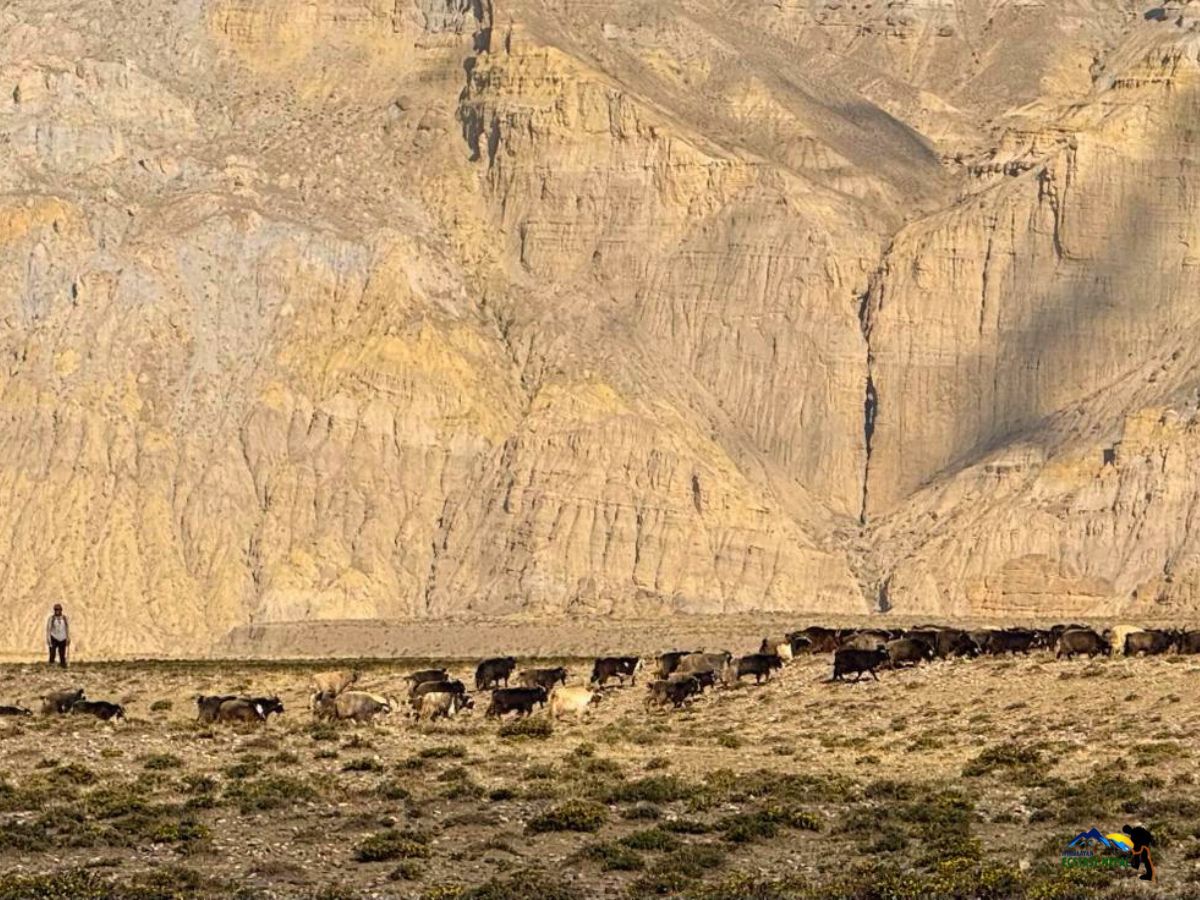
This 21-day Upper Mustang Camping Trek leads you into the ancient Kingdom of Lo, a high-altitude desert region in northern Nepal that was sealed from the outside world until 1992. Over 18 days, the route combines a classic teahouse trail through medieval villages and sacred cave monasteries with a remote camping loop through highland yak pastures and high passes, finishing at the pilgrimage site of Muktinath. [Coordinates: 29.1833° N, 83.9667° E]. Himalayan Ecstasy Nepal handles all permits, guide logistics, and full camping support so you can focus entirely on the journey. If you have been waiting for a trek that goes deeper than the trails everyone else walks, this is it.
Grade: Moderate
Trip Overview
Maximum Altitude4,430 m
Group Size1 - 20
StartsKathmandu
EndsKathmandu
ActivitiesTrekking, Camping
Best TimeAll seasons
TREK HIGHLIGHTS
Fly from Pokhara to Jomsom (2,720 m) with views of the Annapurna and Dhaulagiri ranges
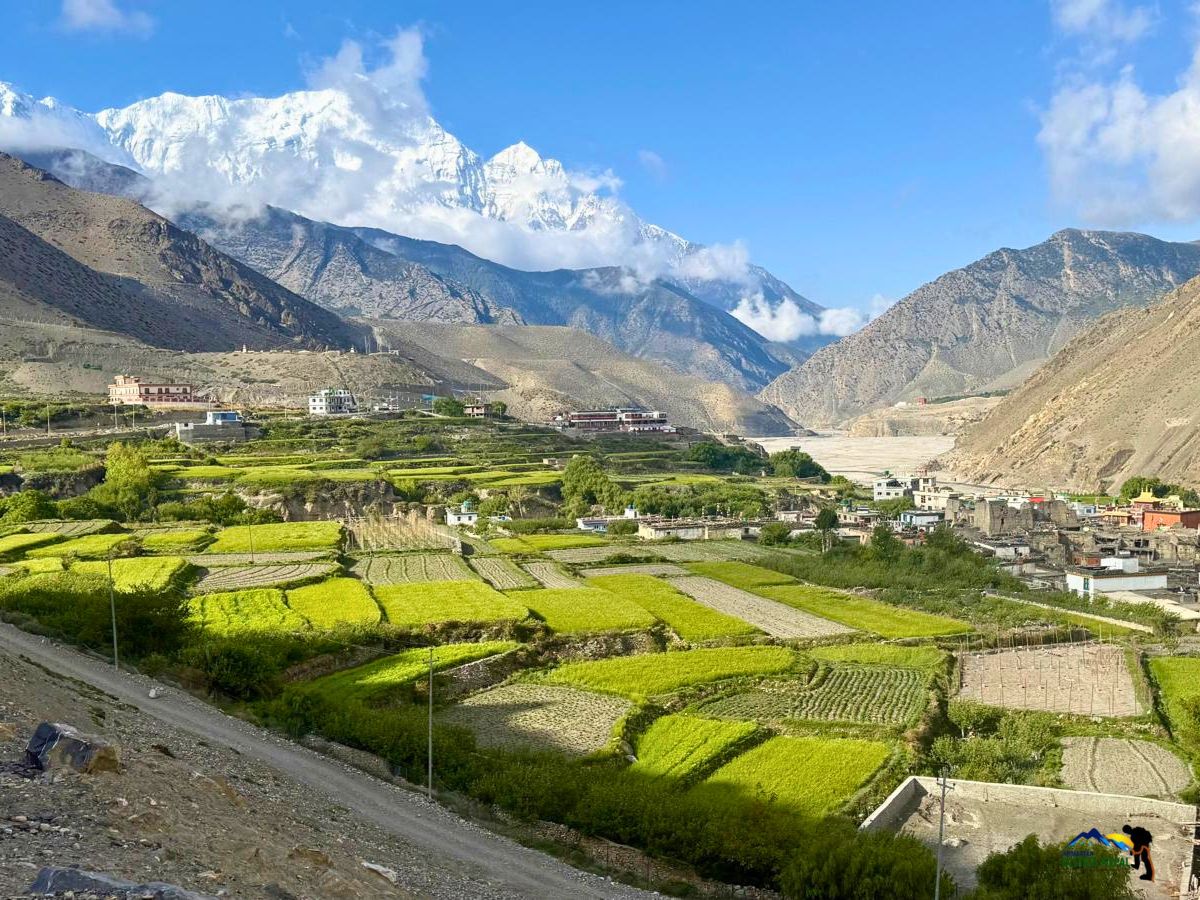
Explore Kagbeni (2,850 m), the historic gateway village at the border of Upper Mustang
Visit Chungsi Cave (Ranchung Cave), a natural 8th-century meditation site of Guru Rinpoche (Padmasambhava)
Trek to Lo Manthang (3,840 m), the medieval walled capital of the former Kingdom of Lo
Explore Ghar Gompa (Lo Gekar, 3,931 m), the oldest monastery in Mustang, dating to the 8th century
Discover Luri Gompa, a 14th-century cave monastery set 100 meters above a sandstone cliff, accessible from Yara
Complete a remote 4-day camping expedition through isolated highland pastures, adding adventure and access to rarely visited parts of Upper Mustang.
Conclude at the sacred pilgrimage site of Muktinath (approximately 3,760 m), revered by both Hindus and Buddhists
What to Expect in the 21-Day Upper Mustang Camping Trek?
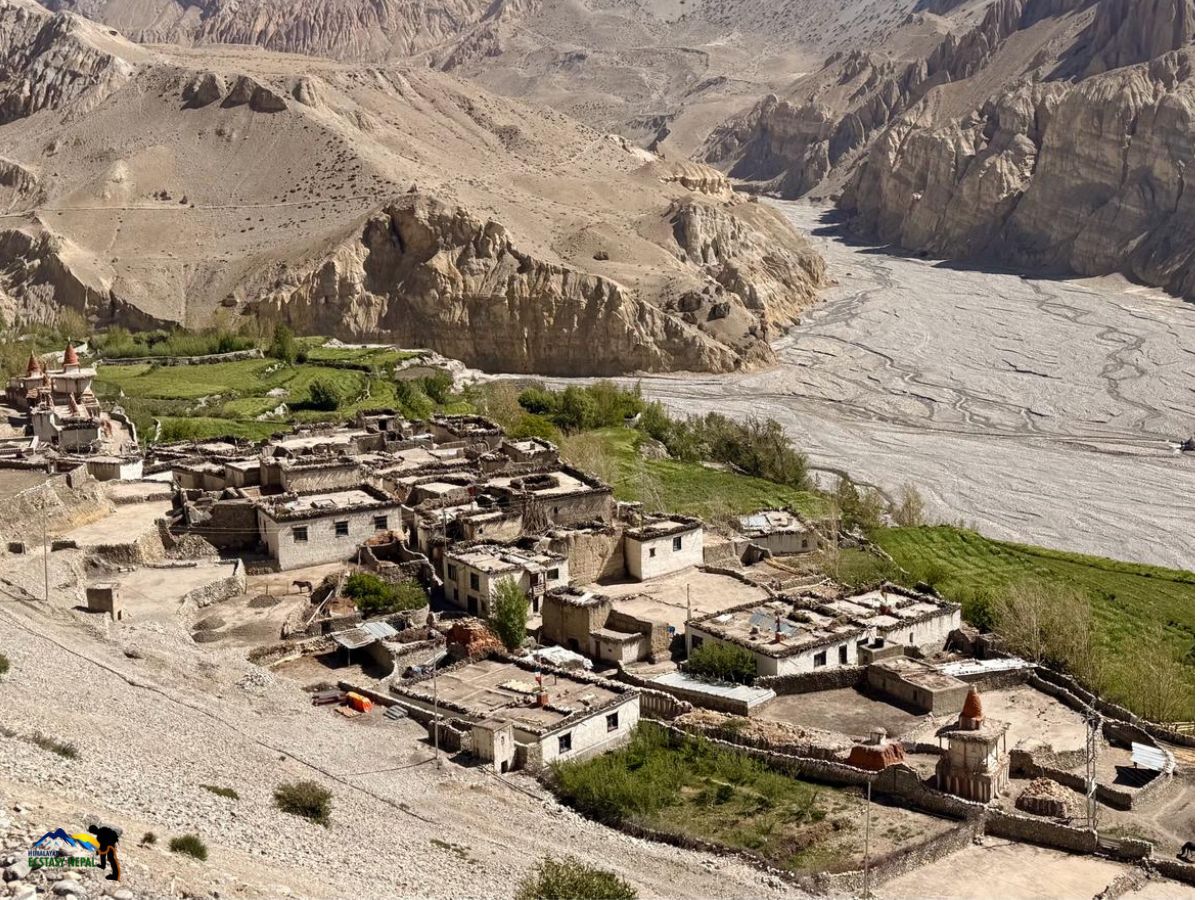
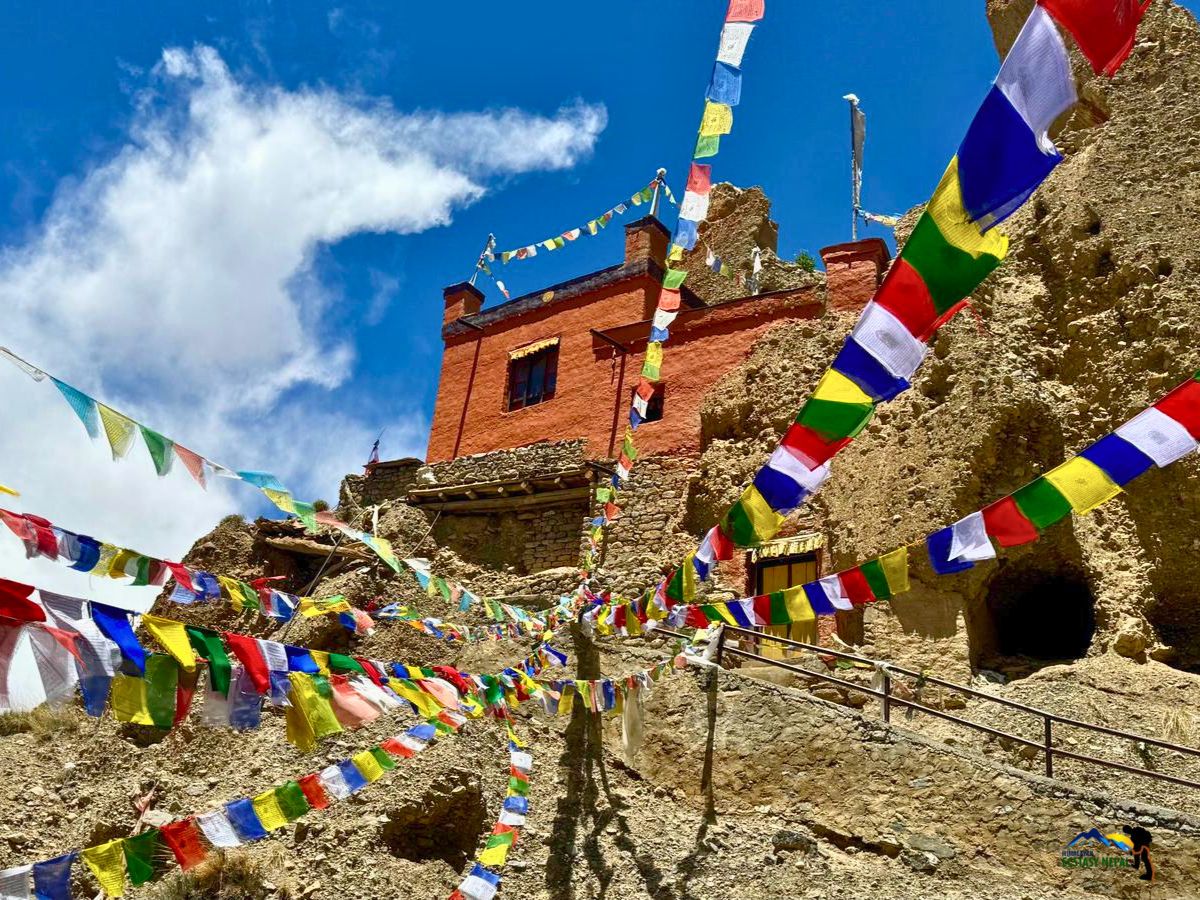
The Upper Mustang Trek takes you into one of Nepal's most unique landscapes. Unlike typical Himalayan treks, this journey follows a high-altitude desert valley filled with red cliffs, ancient cave monasteries, mud-brick villages, and centuries-old fortresses. The scenery feels more like Tibet than Nepal, which reflects the region's deep cultural roots!
The trek combines both teahouse trekking and wilderness camping. The first section follows established trails through villages such as Kagbeni, Samar, and Syangboche before reaching the historic walled city of Lo Manthang.
Beyond Lo Manthang, the route enters a remote camping section where teahouses disappear and the trail crosses isolated valleys and highland pastures before descending to Muktinath!
Upper Mustang was once the independent Kingdom of Lo and remained closed to foreigners until 1992. This isolation helped preserve its Tibetan-influenced culture, architecture, and Buddhist traditions. Today, the region remains one of the most culturally distinct destinations in the Himalayas.
The trek reaches a maximum altitude of around 4,750 meters. While the altitude is manageable for most trekkers, the route is physically demanding due to its length, remote terrain, and camping days. Our team at HEN has explored every section of this route and understands the unique challenges and rewards of trekking through the ancient Kingdom of Lo.
Although the trek includes camping, it lasts only 4 days (Days 14–17), making it a comfortable way to experience the most remote and rewarding section of Upper Mustang.
Summer (June to August) is also popular among international travelers beyond Spring and Autumn, as the rain-shadow landscape remains accessible while the valleys become greener and less crowded
Other Upper Mustang Trip Options
This 21-day itinerary is our most comprehensive Upper Mustang journey, combining teahouse trekking, a 4-day camping expedition, remote highland routes, major monasteries, sacred Buddhist sites, and a complete traverse to Muktinath.
For travelers with different interests or time constraints, we also offer:
All itineraries can be customized with additional monastery visits and cultural experiences based on your interests. This itinerary is ideal for travelers seeking the complete Upper Mustang experience beyond the standard Lo Manthang route.
Why Trek the Upper Mustang with Himalayan Ecstasy Nepal
We use higher trekking routes where possible to avoid busy road sections and provide a more authentic Upper Mustang experience
We have carefully designed this itinerary through extensive research of Upper Mustang's monasteries, sacred Buddhist sites, history, and cultural heritage.
We take you beyond the standard route by incorporating important spiritual and cultural landmarks that many itineraries overlook.
We provide detailed insights into the history, significance, and traditions behind the monasteries, caves, and religious sites you visit.
We combine teahouse trekking with remote camping sections to give you a broader and more authentic experience of Upper Mustang.
We include off-the-beaten-path valleys, viewpoints, and cultural sites that are often missed by regular trekking groups.
We focus on helping you understand the former Kingdom of Lo, not just walk through it.
We design our itineraries around the overall experience rather than rushing between destinations.
We prioritize cultural immersion, local interaction, adventure, and meaningful exploration throughout the journey.
We use our firsthand experience of the region to create a trek that offers genuine value for your time and investment.
We aim to give you a complete Upper Mustang experience that combines history, Buddhism, landscapes, local culture, and remote Himalayan adventure in a single journey.
Main Attractions of Upper Mustang Trek
Upper Mustang holds more cultural and historical depth per square kilometer than almost anywhere in the Himalayan region of Nepal! Here is what our team considers the essential highlights of this route:
Kagbeni: The Ancient Gateway to Upper Mustang
Sitting at the confluence of the Kali Gandaki and Jhong Khola rivers at 2,850 meters, Kagbeni is a dense cluster of mud-brick houses that marks the official start of the restricted zone. The old Tibetan-style monastery here, known locally as Kag Chode Thupten Samphel Ling, is active and worth visiting with your guide.
The red house your guide will point out near the village dates to around 1976, a remnant of the Khamparesistance era when Tibetan guerrilla fighters used this area as a base of operations.
Walk the narrow alleys slowly. Almost every wall carries a rich history!
Chusang and the Tangbe Apple Village
Before reaching Chusang (approximately 2,950 m), the trail passes through Tangbe, a compact farming village known for its apple orchards, buckwheat fields, and traditional architecture. It is a good place to stop for tea or lunch.
Then comes Chusang, which itself holds a cave monastery carved into the cliff face, believed to be 800 to 900 years old! There is also an older nunnery here that is no longer active as a nunnery but remains a place of quiet historical significance. Ask your guide to show you both, and we're sure he'll be happy to guide you through!
Chungsi Cave (Ranchung Cave)
Located between Samar and Syangboche, this natural cave is one of the most spiritually significant sites in all of Mustang. Unlike the thousands of man-made sky caves scattered across the region's cliffs, Ranchung Cave is entirely natural.
Local belief holds that Guru Rinpoche (Padmasambhava), the revered master who brought Tantric Buddhism to the Himalayas, meditated here in the 8th century. The cave is also sacred in Hindu tradition, associated with Lord Shiva on his journey to Mount Kailash!
The walls of the cave contain naturally formed shapes that devotees have venerated for generations. The monastery above the cave, where Padmasambhava is believed to have practiced, is still visited by pilgrims from across the Buddhist world.
Ghami Mani Wall
As you pass through Ghami (approximately 3,500 m) on the way to Dagmar, do not walk past without stopping. Well, Ghami is home to the longest mani wall (a long row of prayer stones inscribed with Buddhist mantras) in the Lo Manthang region.
The wall is an extraordinary sight, stretching across the landscape and built stone by stone over centuries. Eat your lunch here and take time to walk along it. It is one of those sights that does not photograph well but stays in your memory!
Ghar Gompa (Lo Gekar Monastery)
Situated at 3,931 meters near Marang village and accessed on the route between Dagmar and Charang, Ghar Gompa is the oldest monastery in Mustang, dating to the 8th century. It is considered contemporaneous with Samye Monastery in Tibet, the first monastery ever established in that region.
Guru Rinpoche (Padmasambhava) is credited with founding it, and the monastery is rooted in the Nyingma sect of Tibetan Buddhism. The interior holds ancient murals, sacred texts, and a large statue of Guru Rinpoche. Standing inside it, surrounded by frescoes over a thousand years old, is a genuinely rare experience!
Lo Manthang: The Walled Capital of the Ancient Kingdom of Lo
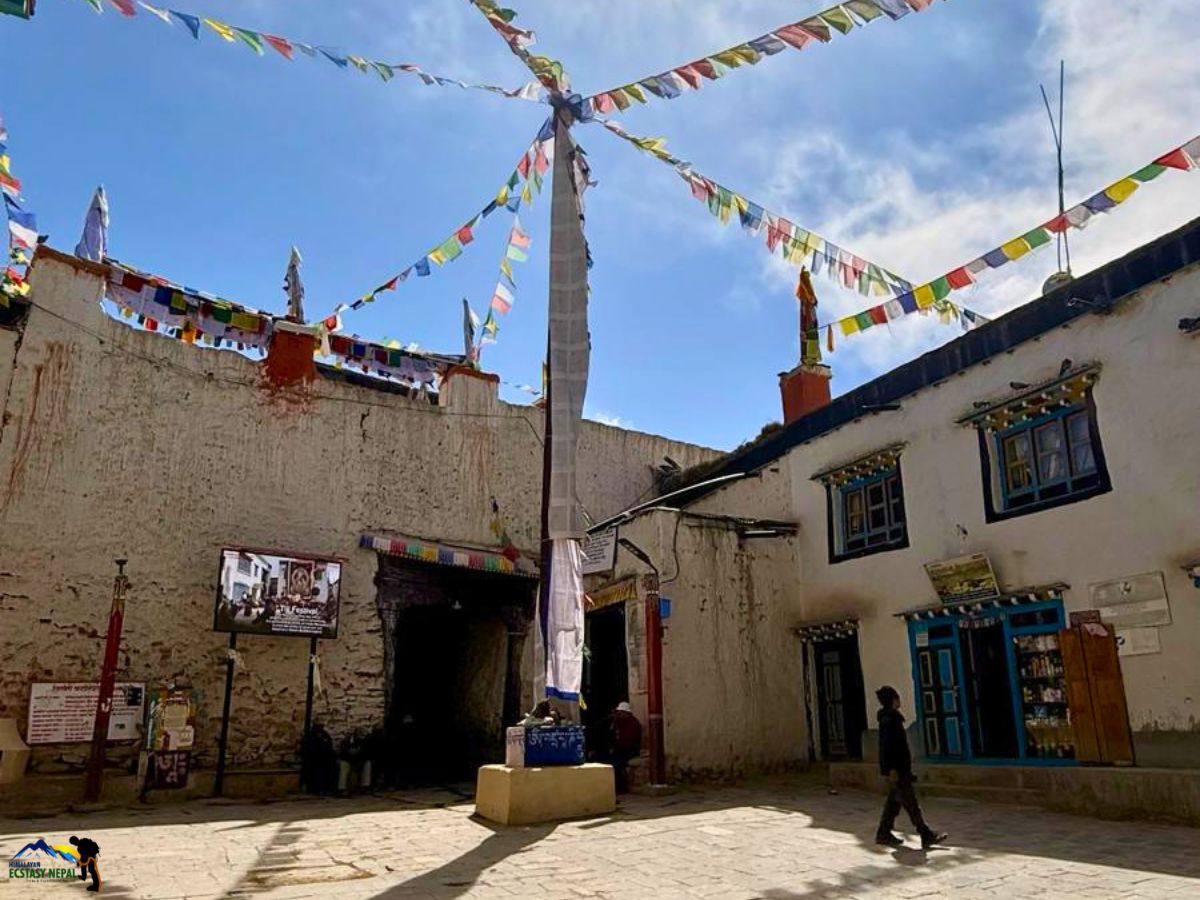
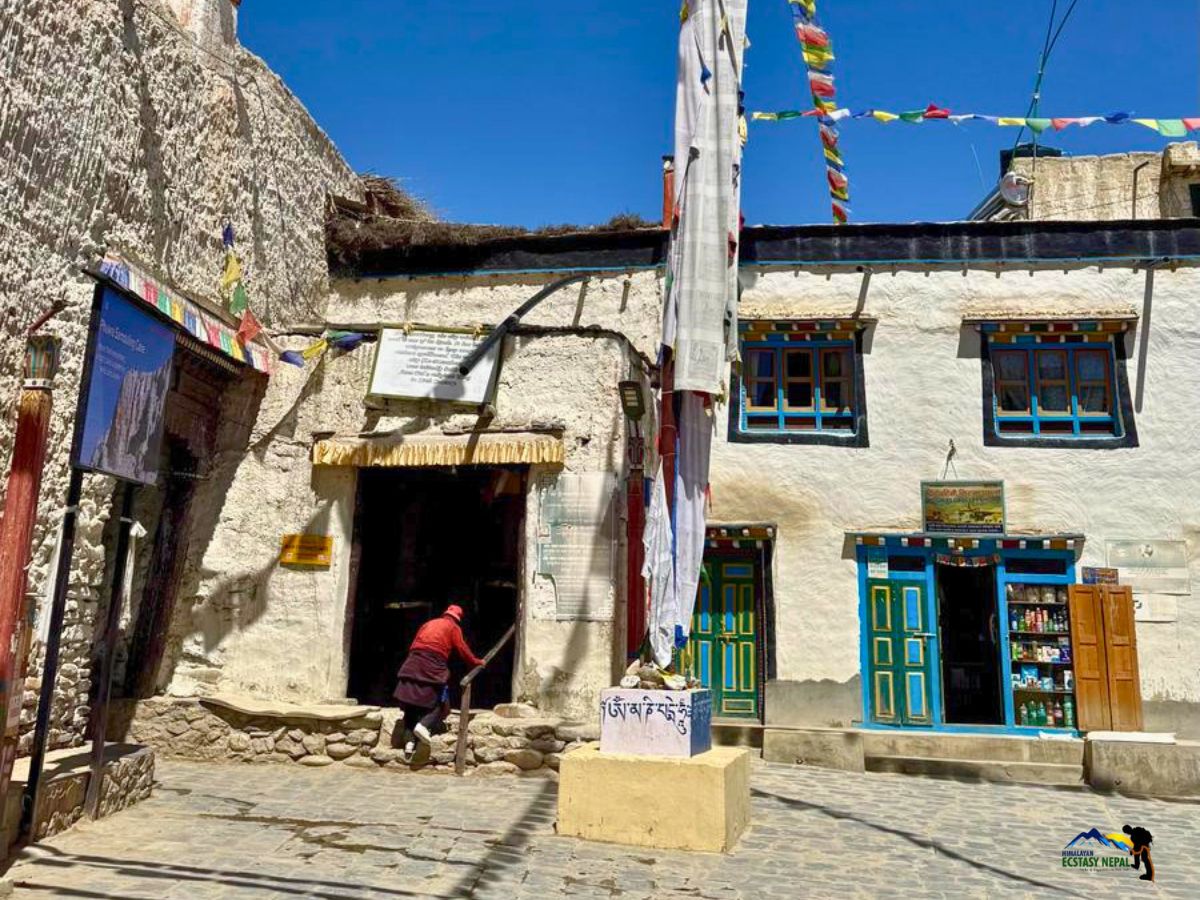
Founded in 1380 by King Ame Pal, this walled city at 3,840 meters was the capital of the Kingdom of Lo for centuries!
The mud-brick walls that surround it are approximately 20 feet high and enclose a maze of narrow alleys, whitewashed houses, and monastic complexes built directly into the urban fabric. The royal palace, Tashi Dyaphel, stands at the center.
The three main monasteries inside the walls, Chode, Thubchen, and Jampa, are open twice daily and hold extraordinary collections of ancient murals, thangkas (religious scroll paintings), and wooden carvings. Plan two full days here!
The site of Lo Manthang, seen for the first time as you descend toward it from Marangla Pass is one of the great views on any trek in Nepal.
Sky Caves of Chhoser (Chosar)
Niphu Cave Monastery
Located about two hours by jeep from Lo Manthang, the sky caves of Chhoser are carved into the cliff faces high above the valley floor. These multi-storey cave dwellings, some reaching 2,000 to 2,500 years in age, were used for habitation, burial, and meditation.
Exactly how the inhabitants accessed them without modern equipment remains an open question! The nearby Niphu Monastery, associated with the Nyingma tradition, is a good lunch stop on the same day.
Luri Gompa: A Hidden Cave Monastery
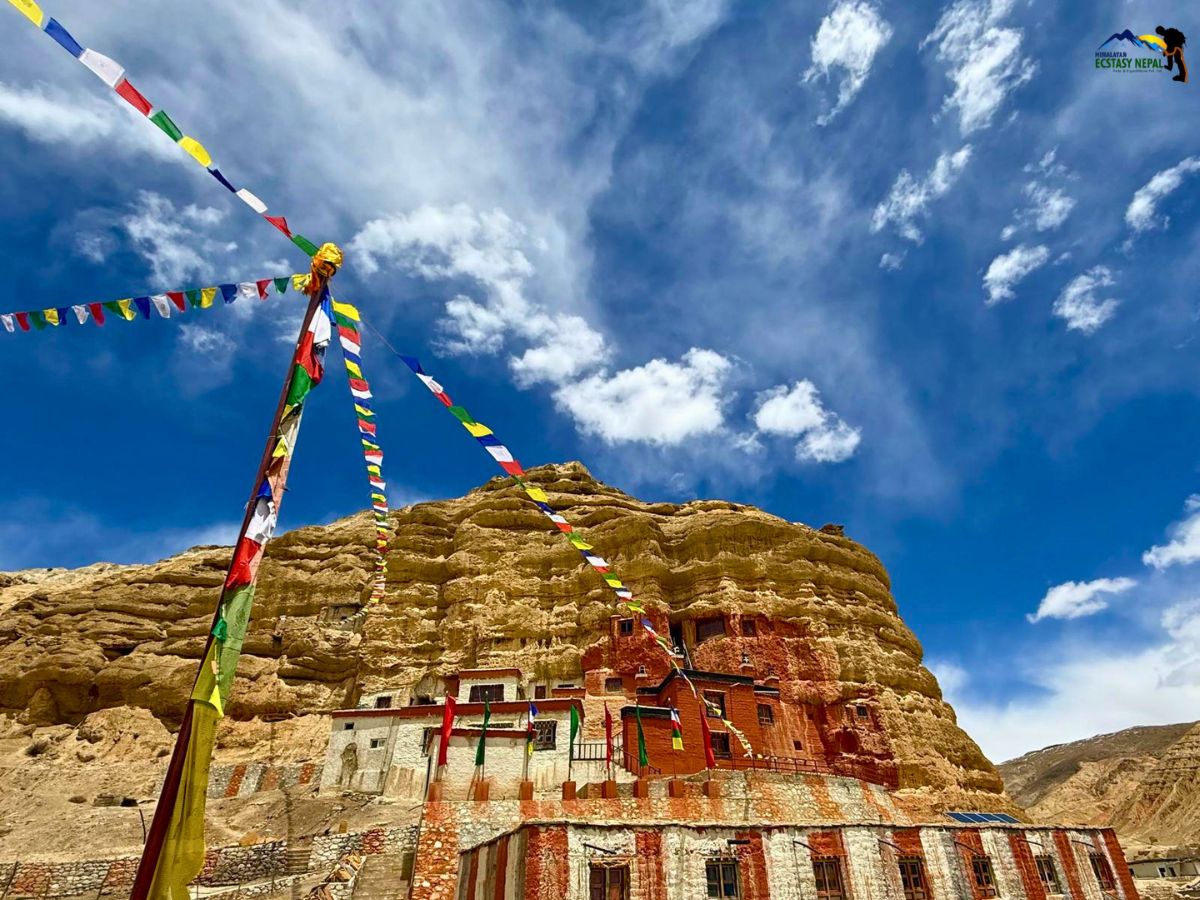
Set 100 meters above the valley floor on a steep sandstone cliff, Luri Gompa is a 14th-century cave monastery near the villages of Yara and Ghara. The inner chamber holds extraordinary 14th to 15th-century murals depicting Buddhist Mahasiddhas (great masters of tantric practice) and a large painted chorten.
It takes 4 to 5 hours to walk there from Yara and return via Ghara. The walk itself passes through barren cliffs and wide open valleys. This is one of the least visited but most rewarding sites on the whole trek that you get to do with Himalayan Ecstasy Nepal!
Muktinath: Where Hindu and Buddhist Traditions Meet
Located at 3,800 meters, Muktinath is one of the most sacred pilgrimage sites in Nepal and a major highlight of the Upper Mustang tour. The temple is dedicated to Lord Vishnu and is revered by Hindus as a place of spiritual liberation. Pilgrims come to bathe beneath the 108 water spouts and offer prayers at this centuries-old shrine.
Muktinath is equally important to Buddhists, who know it as Chumig Gyatsa and regard it as a sacred site associated with Guru Rinpoche.
Nearby attractions include the eternal flame of Jwala Mai Temple, ancient monasteries, and sweeping views of the Kali Gandaki Valley. The unique blend of Hindu and Buddhist traditions makes Muktinath one of Mustang's most significant cultural landmarks.
Upper Mustang Trek with 4 Days Camping Itinerary
Only Days 14 to 17 are camping days. This adventurous extension explores remote valleys, excellent viewpoints, ancient caves, historic monasteries, and lesser-visited heritage sites, making the Upper Mustang experience more complete than the standard trek.
Kathmandu to KathmanduExpand all
Max Altitude: 1,400 m Meals: Welcome DinnerAccommodation: 3-Star HotelTransportation: Private
Max Altitude: 1,400 m Meals: BreakfastAccommodation: 3-Star Hotel
Max Altitude: 2,850 m Meals: B, L, DAccommodation: Local LodgeTransportation: Flight Kathmandu–Pokhara, Flight Pokhara–Jomsom, Private vehicle to Kagbeni
Max Altitude: 2,950 m Meals: B, L, DAccommodation: Local Lodge
Max Altitude: 3,600 m Meals: B, L, DAccommodation: Local Lodge
Max Altitude: 3,700 m Meals: B, L, DAccommodation: Local Lodge
Max Altitude: 3,830 m Meals: B, L, DAccommodation: Local Lodge
Max Altitude: 3,500 m Meals: B, L, DAccommodation: Local Lodge
Max Altitude: 3,840 m Meals: B, L, DAccommodation: Local Lodge
Max Altitude: 3,840 m Meals: B, L, DAccommodation: Local LodgeTransportation: Private jeep for Chhoser Excursion
Max Altitude: 3,700 m Meals: B, L, DAccommodation: Local Lodge
Max Altitude: 3,700 m Meals: B, L, DAccommodation: Local Lodge
Max Altitude: 3,370 m Meals: B, L, DAccommodation: Local Lodge
Max Altitude: 4,100 m Meals: B, L, DAccommodation: Tent
Max Altitude: 4,200 m Meals: B, L, DAccommodation: Camp
Max Altitude: 4,150 m Meals: B, L, DAccommodation: Camp
Max Altitude: 4,330 m Meals: B, L, DAccommodation: Camp
Max Altitude: 2,780 m Meals: B, L, DAccommodation: Local Lodge
Max Altitude: 2,720 m Meals: B, L, DAccommodation: Local Lodge
Max Altitude: 1,400 m Meals: B, L, DAccommodation: 3-Star HotelTransportation: Flight Jomsom–Pokhara, Drive Pokhara–Kathmandu
Max Altitude: 1,400 m Meals: BreakfastTransportation: Private vehicle to airport
Trip Cost Details
Includes
Airport transfers on arrival and departure by private vehicle
3 hotel nights in Kathmandu in a 3-star hotel
All accommodation during trekking days
Restricted Area Permit (RAP) for Upper Mustang and Annapurna Conservation Area Permit (ACAP)
Licensed English-speaking guide with salary and insurance
All meals on trekking days: breakfast, lunch, and dinner
Tea and coffee at breakfast and dinner
Porter support (1 porter per 2 trekkers, carries 20 to 22 kg)
Full camping equipment for the camping section (tents, sleeping mats, cook tent, cooking equipment)
Cook team for the camping section
Pokhara to Jomsom flights (both ways, approx. $190/person) - we offer to let you choose jeep too (check below for price)
Kathmandu to Pokhara flight
All ground transportation as per the itinerary
All logistical arrangements
Excludes
Personal expenses
International flights
Nepal tourist visa fee
Personal travel and health insurance covering emergency evacuation
Meals outside the itinerary
Hot showers, Wi-Fi, and battery charging fees at teahouses
Laundry
Personal gear and clothing
Costs arising from natural disasters, weather, or anything outside our control
Early departure costs and non-refundable expenses
Tips for guides, porters, and cook staff
Any service not listed above
Optional Extra Services
Additional porter: USD 460 per porter
Private Jeep (Pokhara–Kagbeni or Kagbeni–Pokhara): USD 250 one way
Shared Jeep (Pokhara–Kagbeni or Kagbeni–Pokhara): USD 165 per person one way (based on 3 travelers)
Single room supplement (available on request)
Trip Gallery
See More
Essential Information
Best Time to Visit Upper Mustang
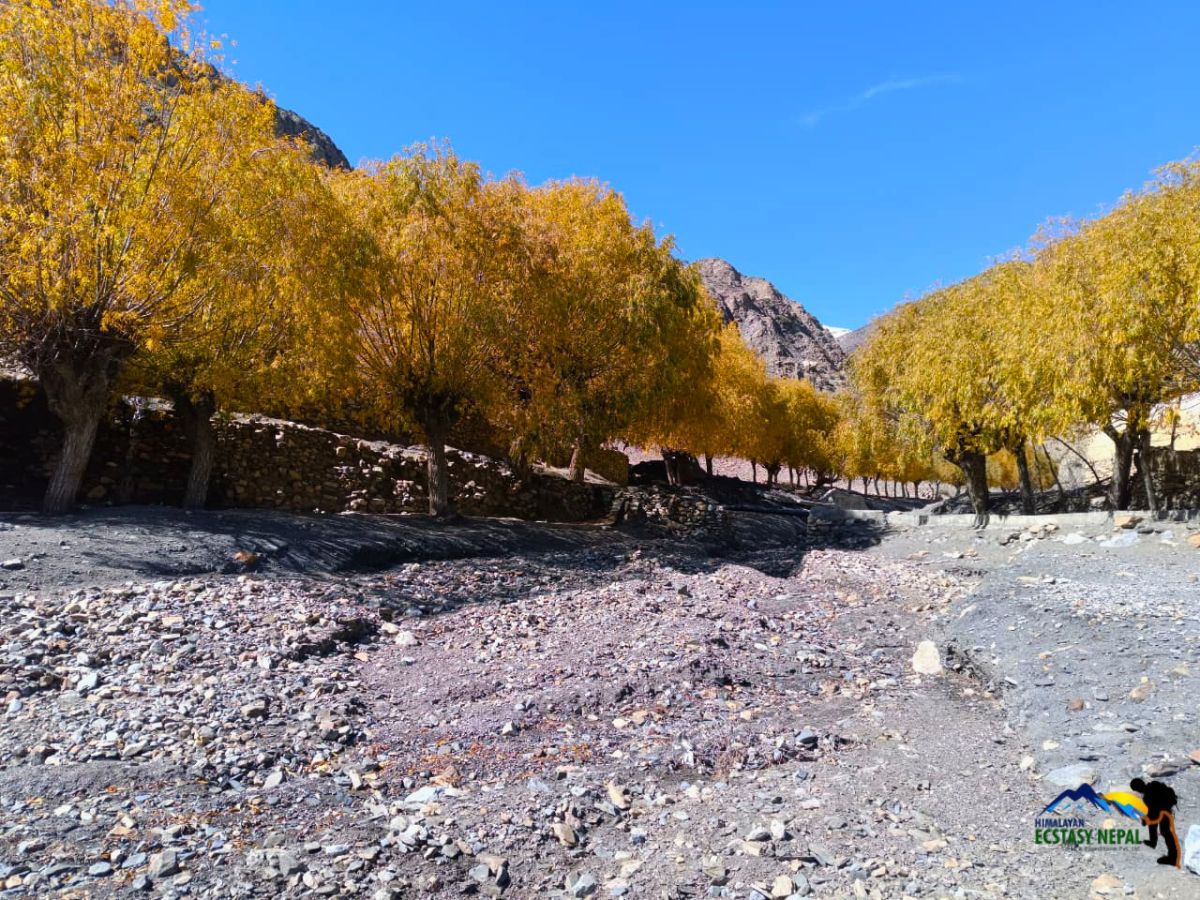
Autumn in Upper Mustang
Spring (March to May) and autumn (late September to November) are the best seasons for the Upper Mustang Trek. Spring brings clear skies, mild temperatures, and the famous Tiji Festival in Lo Manthang, making it one of the most popular times to visit.
Autumn offers excellent mountain views, stable weather, and comfortable trekking conditions after the monsoon.
Unlike most trekking regions in Nepal, Upper Mustang lies in the rain shadow of the Annapurna and Dhaulagiri ranges. This means trekking is still possible during the monsoon months (June to August), with fewer crowds and greener landscapes. Strong afternoon winds are common, especially in the Kali Gandaki Valley, so a windproof layer is essential.
Winter (December to February) is much colder, and some teahouses may close. However, trekkers who can handle the conditions are rewarded with peaceful trails and a quieter experience.
Permits Required For Upper Mustang Camping Trek
Two permits are required for the Upper Mustang Trek: the Restricted Area Permit (RAP) and the Annapurna Conservation Area Permit (ACAP).
The RAP is mandatory for all trekkers entering Upper Mustang and must be arranged through a registered trekking agency, like Himalayan Ecstasy Nepal, ourselves. So, independent trekking is not allowed, and a licensed guide is compulsory for this trek.
The permit fee has now been upgraded by the Government of Nepal, and it costs USD 50 per person per day!
Well, our team at HEN arranges all necessary permits and camping fees before your trek, allowing you to begin your journey without any administrative hassle!
Difficulty Level of Upper Mustang Trek
The Upper Mustang Trek is graded as Moderate. The maximum altitude on this itinerary reaches approximately 4,430 meters at Norshing La Pass. Lo Manthang, where you spend two nights, sits at 3,840 meters.
Unlike many Himalayan treks, the challenge here comes less from altitude and more from cumulative distance, wind exposure, and the remoteness of the camping section, where there are no villages, no teahouses, and no option to turn back easily.
Daily walking during the teahouse section ranges from 3 to 6 hours on varied terrain of rocky trails, river crossings, and open desert paths. The camping section demands 4 to 6 hours of walking per day on exposed high-altitude terrain (but with a loaded porter carrying your main bag).
This trek suits trekkers with reasonable fitness who can walk consistently for multiple days without needing a rest. No technical climbing skills are required, and there are no glaciated or technical passages on the standard route.
Prior high-altitude trekking experience is helpful but not essential if you are fit and well-prepared. However, age is not a barrier!
And our HEN team has guided trekkers of many ages through this route successfully. The key requirement is steady endurance and a good attitude toward basic conditions.
The camping section particularly demands that you are comfortable with cold nights, simple meals, and days when the scenery is the only entertainment. If you train consistently for 6 to 8 weeks before the trek, you will be well-prepared!
Accommodation and Food
From Jomsom to Tange, the route uses teahouses and local lodges. These are comfortable by trekking standards, with twin rooms, shared bathrooms, and dining rooms where your team gathers each evening. Still, do not expect luxury!
Rooms are clean and functional, hot showers are available at most stops for a small extra charge, and Wi-Fi and phone charging typically carry an additional fee as well.
The further north you go, the simpler the facilities become. By the time you reach Lo Manthang, rooms and meals are still good but noticeably more basic than Kagbeni or Chusang. That contrast is part of the Upper Mustang Trek experience!
After Tange, the teahouses end. From Papas camp onward, our team at HEN will provide you with full camping support with tents, sleeping mats, and a cook team.
Talking about meals, throughout the teahouse section, they include a wide range of local and international options. Dal bhat (lentil soup with rice and vegetables) is the staple and genuinely the best fuel for long trekking days.
Most teahouses also serve noodle soups, pasta, eggs, porridge, and simple Western dishes. Apple products are a specialty of this valley, and you will find apple pie, apple brandy, and fresh apples at multiple stops.
Moving on, we'll provide you with drinking water that's always treated or give you the option to purchase bottles (wherever available).
During the camping section, our cook team prepares all meals. The food is simple but hearty: soups, rice, noodles, and dal designed for high-altitude energy needs!
Still, we suggest carrying some personal snacks, electrolyte powder, and a water purification method just in case.
How to Prepare for This Upper Mustang Camping Trek
Physical Preparation
The Upper Mustang Trek requires the ability to walk 5 to 6 hours daily for up to 14 consecutive trekking days, including several days in the 4,000 to 4,430-meter range during the camping section.
Begin training 6 to 8 weeks before your departure. Focus on cardiovascular fitness through daily uphill walking, cycling, or jogging. Strengthen your legs with squats, lunges, and step-ups.
And if possible, complete a shorter multi-day hike carrying a loaded pack before the trek to condition your body for consecutive days on the trail.
Mental Preparedness
The camping section of this trek is genuinely remote. The days are long and the terrain is exposed. There will be stretches where the landscape is the main entertainment, and that demands patience and a calm mindset!
The reward is a quality of silence and solitude that is increasingly rare in the trekking world. Go in knowing what the route asks of you, and you will surely find it manageable!
Altitude Sickness and Preventive Measures
Most of this trek stays below 4,000 meters, which significantly reduces the risk of serious altitude sickness compared to treks like Everest Base Camp. However, the camping section crosses passes near 4,200 to 4,400 meters.
So, you should still watch for early symptoms of altitude sickness: persistent headache, nausea, unusual fatigue, and disturbed sleep.
Remember: ascend slowly, stay well hydrated, and always inform your guide immediately if symptoms appear. Consult a doctor before your trek to discuss altitude medication and whether it is appropriate for you.
Hydration and Nutrition
Drink at least 3 to 4 liters of water daily throughout the trek. The high-altitude desert environment of Mustang is dry and dehydrating even when temperatures feel moderate.
At that altitude, your appetite often drops, but you must eat regularly to maintain energy!
Travel Insurance
Travel insurance is essential for this trek and also legally compulsory (required for RAP processing)!
Keep in mind that your policy must cover high-altitude trekking to at least 4,500 meters, emergency helicopter evacuation, medical treatment, and trip cancellation.
In the remote camping section, helicopter rescue is the only emergency evacuation option.
Equipment Lists
Proper preparation matters on any Himalayan trek. For the Upper Mustang Trek, you will be moving through high-altitude desert terrain ranging from 2,700 m to 4,430 m, splitting your time between teahouses and a self-supported camping section. Wind is as much a factor as cold.
Every trekker must carry the right clothing and gear to stay safe and comfortable throughout. Here is what our HEN team recommends:
Head
Sun hat with a wide brim or cap for protection from the intense high-altitude sun
Warm beanie or fleece hat for cold mornings, evenings, and the camping section
Buff or neck gaiter for wind, dust, and cold, which is essential in the Kali Gandaki valley
Headlamp with extra batteries for early morning starts and camp use
Sunglasses with full UV protection to shield your eyes from strong desert-altitude sunlight
Upper Body
Thermal base layers (2 to 3) to keep the body warm and wicking
Fleece jacket for insulation during cold weather
Waterproof and windproof jacket, essential for the afternoon winds and exposed camping terrain
Down jacket for evenings, camp, and the high passes
Lightweight trekking shirt, long sleeve recommended for sun protection
Hands
Lightweight liner gloves for mild conditions and teahouse evenings
Warm fleece or softshell gloves for trekking in colder areas and pass crossings
Waterproof insulated mittens for very cold conditions during the camping section
Lower Body
Thermal leggings or base layer pants for warmth at altitude
Trekking trousers (1 to 2 pairs) in quick-dry material
Softshell trousers for higher altitude sections and wind exposure
Waterproof rain pants for protection during unexpected rain or snow
Trekking shorts optional for lower altitude stages
Foot Wear
Waterproof trekking boots with strong ankle support, worn in before the trek
Camp shoes or sandals for resting at teahouses and in camp
Trekking socks (3 to 4 pairs) in wool or synthetic material
Liner socks to reduce blister risk
Gaiters for snow, mud, and rocky stream crossings
Travel Documents
Passport and Nepal visa
Travel and medical insurance documents
Airline tickets or e-tickets
Passport-size photos for permits
Cash in Nepalese rupees for personal expenses on the trail
Copies of all important documents kept separately
Sun Stuffs
Sunscreen with SPF 50 or higher, reapplied frequently at altitude
Lip balm with SPF, as the dry desert air cracks lips quickly
Toiletries
Toothbrush, toothpaste, and biodegradable soap
Moisturizer and hand sanitizer
Quick-dry towel
Toilet paper and wet wipes
Eating & Drinking
Energy bars or granola bars for long days between meals
Nuts and dried fruits
Chocolate and trail mix
Electrolyte powder or energy drink mix, particularly important for the camping section
Crackers or biscuits
Sleeping Bags
Warm sleeping bag rated to -10 to -15 degrees Celsius for cold nights in the camping section
Sleeping bag liner for added warmth and hygiene
Compression sack or waterproof bag to keep your sleeping bag dry
Bag Packs
Main trekking backpack (40 to 60L) for carrying personal gear if trekking without a porter
Daypack (20 to 30L) for daily essentials including water, snacks, camera, and extra layers
Rain cover for your backpack
Dry bags or waterproof stuff sacks for keeping electronics and documents dry
Medical & First Aid
Diamox (Acetazolamide) if prescribed and recommended by your doctor for altitude
Paracetamol or Ibuprofen for headache, pain, or fever
Anti-diarrhea medication
Oral Rehydration Salts (ORS)
Antibiotics if prescribed by your doctor
Anti-nausea medication
Cough and cold medicine
Throat lozenges
Antihistamines for allergies
Blister treatment
Antiseptic cream or wipes
Adhesive bandages
Elastic bandage for minor sprains
Personal prescription medications
Water purification tablets or a portable filter, essential for the camping section
Miscellaneous
Trekking poles reduce knee strain on descents and are strongly recommended for the long downhill sections
Reusable water bottles or a hydration bladder with a minimum capacity of 2 liters
Power bank for charging devices, as electricity is limited at higher elevations and unavailable in camp
Camera case or waterproof protection for electronics in dust and wind
Universal travel adapter supporting Nepal's 230V, 50Hz standard
Personal towel for drying
Small notebook and pen for journaling, permits, or personal notes
Upper Mustang Trek with 4 Days Camping FAQs
No, Upper Mustang is a restricted area and a licensed guide is mandatory for all trekkers. Your Restricted Area Permit must also be arranged through a registered Nepalese trekking agency. Independent trekking north of Kagbeni is not permitted under any circumstances
You need to be able to walk 4 to 6 hours daily for up to 14 consecutive days, including several days at altitudes between 4,000 and 4,430 meters. You should should begin cardiovascular training 6 to 8 weeks before departure. Practice with loaded daypack hikes on consecutive days if possible!
Tell your guide immediately if you notice persistent headache, nausea, unusual fatigue, or breathing difficulty. Your guide is trained to assess symptoms and make decisions about descent.
In the teahouse section, a jeep or vehicle can often reach the trail. In the camping section, emergency helicopter evacuation is the only option, which is why verified travel insurance is essential before you go!
Yes, HEN can adjust the itinerary based on your pace, interests, and available days. If you want to add extra time in Lo Manthang, skip certain stops, or connect the Upper Mustang route to the Annapurna Circuit, contact us directly and we will build an itinerary around your needs.
Tiji is a three-day Tibetan Buddhist festival held annually in Lo Manthang, typically in May. It features elaborate masked dances and rituals re-enacting the victory of a Buddhist deity over a demon. Witnessing Tiji in Lo Manthang is a rare cultural experience. If your dates overlap with the festival, plan to spend extra time in Lo Manthang!
NTC (Nepal Telecom) SIM cards offer the most reliable coverage on this route. Signal is available in most larger villages, but becomes very limited or nonexistent in the high camping section between Tange and Muktinath. Let family or friends know in advance that you will be unreachable for several days during this section!
Yes, more than most people expect. Because Upper Mustang lies in the rain shadow of the Annapurna and Dhaulagiri ranges, monsoon rainfall is minimal compared to other trekking regions. The trails are quieter, fees are the same, and the landscape takes on unexpected green tones. Be aware that some jeep roads in the lower section can become difficult in heavy rain, and check conditions with your operator before confirming monsoon season dates.
You arrive in Kathmandu, and our team meets you at Tribhuvan International Airport with a transfer to your 3-star hotel in Thamel. This evening is yours to rest, adjust to Nepal time, and get ready for the journey ahead!
Our team handles your Restricted Area Permit and ACAP in the background today.
We recommend spending the morning exploring Thamel for any last-minute gear you may need, and the afternoon at one of Kathmandu's UNESCO World Heritage Sites, such as Boudhanath Stupa or Pashupatinath Temple.
Later in the evening, we will brief you on the trek, so be sure to meet us!
An early flight takes you to Pokhara, followed by a short scenic flight of approximately 20 minutes to Jomsom with aerial views of the Annapurna and Dhaulagiri mountains.
From Jomsom, a roughly one-and-a-half-hour drive brings you to Kagbeni, the historic gateway village and the formal entry point into the Upper Mustang restricted zone.
Your guide introduces you to the village, including the active monastery and the remnants of the Khampa-era red house from the mid-1970s.
The trail heads north from Kagbeni through increasingly arid terrain with approximately 3 hours of walking.
On the way, you pass through Tangbe, an old farming village surrounded by apple orchards and terraced fields, which makes a good tea stop.
Chusang is a compact village with a cave monastery carved into the cliff above the settlement, believed to be 800 to 900 years old.
This is a longer day of 4 to 5 hours, climbing gradually up into the eroded canyon landscape that defines the mid-section of Upper Mustang.
The trail passes a striking abandoned settlement on the opposite side of a suspension bridge. This old village, with no lodge or hotel, is accessible only on foot and is a rare sight of a truly uninhabited Mustang community.
Upon reaching Samar, you get good views of the surrounding ridgelines!
Today's walk of 3 to 4 hours includes a detour to Chungsi Cave (Ranchung Cave), located between Samar and Syangboche.
The final approach to the cave requires a short uphill climb from the valley floor. Your overnight is going to be in Syangboche, which is going to be another memorable part of the trip.
A longer day on trail passes through the beautiful villages of Ghiling and Ghami before arriving at Dagmar. Ghami is home to the longest mani wall in the Lo Manthang region, a centuries-long row of prayer stones that stretches across the landscape. Lunch here while facing the walls!
Dagmar has its own deep history. The red-stained cliff face above the village carries a local legend connected to Guru Rinpoche's journey through this region.
The village also has a painting cave and a separate older cave, both part of the layered rock art culture of Mustang that spans 700 to 2,500 years.
Today's route takes a detour to Ghar Gompa (Lo Gekar Monastery) before continuing to Charang. The walk from Dagmar to Ghar Gompa takes approximately 2 hours, then another hour and a half to reach Charang.
Note that Charang is the second-largest village before Lo Manthang and holds its own active nunnery monastery, a royal palace, and a distinctive stupa style unlike anything found further south on the route.
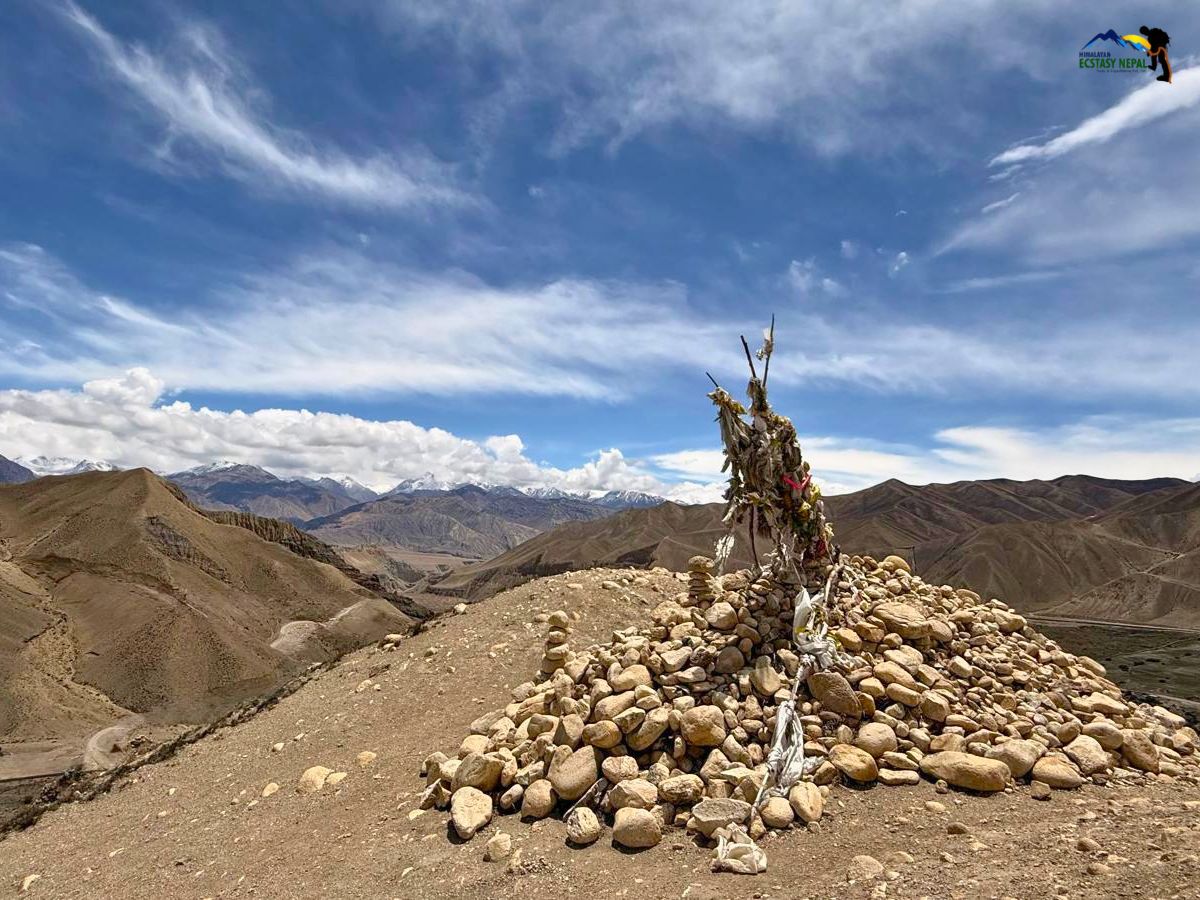
The approach to Lo Manthang crosses Marangla Pass at approximately 4,300 meters, offering one of the most extraordinary panoramic views of the entire trek. Today, you walk 5 to 6 hours.
From the pass, you can see Tibet's border pillars to the north, the Thorong La Peak, Nilgiri South, Centre, and North, Tilicho Peak, and the summit of Annapurna I.
The view of the Tibetan landscape across the border, including pyramid-shaped formations of Tibetan plateau soil, is unlike anything visible from any other vantage point on this route. Lo Manthang reveals itself as you descend!
You get a full day to explore Lo Manthang and its surroundings. The morning begins with a jeep drive of approximately 2 hours to the sky caves of Chhoser (Chosar), ancient multi-storey cave dwellings carved into the cliff face, ranging in age from 2,000 to 2,500 years.
On the return, visit Niphu Monastery for lunch. Back in Lo Manthang, the afternoon is free to explore Gyarpu Monastery and the summer palace.
The three main monasteries inside the walled city, Chode, Thubchen, and Jampa, are open from 8 to 11 am and 3 to 7 pm. Time your visit accordingly!
Leaving Lo Manthang, the route heads south and east, crossing the Kali Gandaki River before climbing to the village of Dhi (approximately 2,900 m) for lunch. The afternoon walk continues to Yara at 3,700 meters, taking 5 to 6 hours in total for the day.
Well, Yara is a small village that serves as the base for visiting Luri Gompa. Two nights here should be enough (read more below).
A 4 to 5-hour round trip from Yara leads to Luri Gompa via Ghara village. On clear days, there is a glimpse of Dhaulagiri from this section of the trail.
After the day trip, you'll return to Yara by late afternoon, and spend the second night here.
A 5 to 6-hour walk brings you down to Tange, a large and fertile village with well-maintained agricultural terraces and ancient chortens that stand at the entrance to the settlement.
Tange is one of the more prosperous-looking villages in Upper Mustang, and the last place with teahouse accommodation before the camping section begins. This is the final night in a proper lodge before several days of camping!
The camping section begins today!
Packed lunch is prepared by our cook team for the first part of the hike. The trail climbs from Tange into open, treeless highland terrain over 4 to 5 hours.
Pa-Pass sits at approximately 4,100 meters and is a yak pasture area with no permanent settlement. Our team sets up camp here for the night. The sky at this altitude, away from any light source, is extraordinary!
A 4 to 5-hour walk crosses a pass at approximately 4,200 meters before descending to the camp at Norshing Khola, a glacial stream fed by meltwater from the mountains above.
Proper views of Dhaulagiri open up on this section. Yak herders and their flocks may be the only other people you encounter.
The camp sits close to the stream, which is the water source as the terrain here is high-altitude desert with no vegetation except sparse highland grasses.
The route today crosses Norshing La Pass at 4,430 meters, one of the high points of the trek. From the pass, the view spans from Muktinath all the way back to Lo Manthang and the Tibetan border. It is a remarkable full-circle panorama!
Khampa sits at 4,150 meters and has good water source available. The name Khampa refers to this area's historical connection with the Khampa fighters, Tibetan resistance soldiers who operated in Upper Mustang in the 1960s and 1970s, using these high valleys as their base.
A 4 to 5-hour walk leads to what our HEN team simply calls Green Camp for its position above a wide yak pasture. The camp sits at 4,330 meters in a broad open valley!
Lo Manthang is visible from the ridge above camp. Sunrise and sunset from this elevation, with nothing blocking the horizon in any direction, are among the most vivid moments of the whole trek.
A 3 to 4-hour walk over Glu La Pass brings you down to Muktinath, the sacred pilgrimage site revered by both Hindus and Buddhists. The views from the descent take in Dhaulagiri, Nilgiri, and the full Annapurna range.
Muktinath Temple is tended by young Buddhist nuns, a rare combination with its status as a major Vaishnava Hindu site.
After visiting the temple complex, you descend to Lupra (approximately 2,780 m), a village of around 900 to 1,000 years in age known for its Bon religion heritage and a unique Bon cave monastery, one of the few active Bon dharma sites in the Mustang valley. You might even encounter some meditating for weeks!
A 2 to 3-hour walk brings you back to Jomsom along the Kali Gandaki valley.
You have the option to visit Marpha rather than Jomsom, which is a historic apple-growing village known as the apple capital of Mustang, with old stone alleys and a quiet village atmosphere.
Otherwise, rest in Jomsom for the afternoon. Those who wish can also visit the site where a Japanese monk stayed for four months, which has become a small place of pilgrimage for visitors.
An early morning flight returns you to Pokhara with a final aerial view of the Mustang landscape. In case you stayed in Marpha, you'll need to drive up to Jomsom in the early morning to catch the flight.
The same day, from Pokhara, a scenic drive or flight brings you back to Kathmandu. The evening is free to explore Thamel, rest, or simply reflect on the journey.
Note: You can spend an extra day in Pokhara for proper rest, too, and let us know if you're looking for a guided Pokhara sightseeing day.
Our team transfers you to Tribhuvan International Airport for your onward flight (around three hours prior). And your Upper Mustang journey with Himalayan Ecstasy Nepal ends here.
We hope you'll choose us again if you revisit Nepal. Or in case you'd like to add extra days on this trip itself, don't hesitate to contact us directly!