Annapurna Base Camp (ABC) sits at 4,130 metres inside the Annapurna Sanctuary in Gandaki Province, at about 28.53° N, 83.88° E. It is a wide basin ringed by Annapurna I, Annapurna South, Hiunchuli, Annapurna III, Gangapurna, and Machhapuchhre (Fishtail). On this 10-day trek, you walk up through Gurung villages and rhododendron forest for five days. Then you fly back to Pokhara by helicopter in about 20 to 25 minutes, so you skip the long walk down.
Grade: PD
Trip Overview
Duration10 Days
Trip GradeModerate
Moderate treks are typically from 3,000 meters to 5,000 meters on varied terrain with longer durations - suitable for seasoned hikers, and beginners with a reasonable level of fitness.
CountryNepal
Maximum Altitude4,130m (Annapurna Base Camp)
Group Size2-20
StartsKathmandu
EndsKathmandu
ActivitiesTrekking with Scenic Heli Flight
Best TimeMarch to May and October to November
TREK HIGHLIGHTS
Sleep at Annapurna Base Camp (4,130m) and watch sunrise on Annapurna I and Annapurna South.
Look up at Machhapuchhre (Fishtail) from its own base camp at 3,700m.
Walk through the Gurung villages of Ghandruk and Chhomrong, on stone steps and slate paths.
Follow the Modi Khola through bamboo and rhododendron forest.
Enter the Annapurna Sanctuary through the narrow gap between Hiunchuli and Machhapuchhre.
Fly back to Pokhara (or Kathmandu) by helicopter and skip the walk down.
Add an optional Bandipur or a Chitwan jungle safari after the trek.
10-Day Annapurna Base Camp Trek With Helicopter Return: What to Expect?
This is how the 10-day trip works, from the drive to Nayapul to the helicopter flight home. It covers the pace, transport, the reserve day, and the safety arrangements.
The Route and The Pace
You drive to Nayapul and walk up to ABC over five days. Then, the helicopter takes you out, so you never walk the same trail twice.
Walking days are 5 to 7 hours, mostly on stone steps and forest path. Skipping the walk down suits trekkers with a short holiday or tired knees, but the climb up is the same as on any other ABC route!
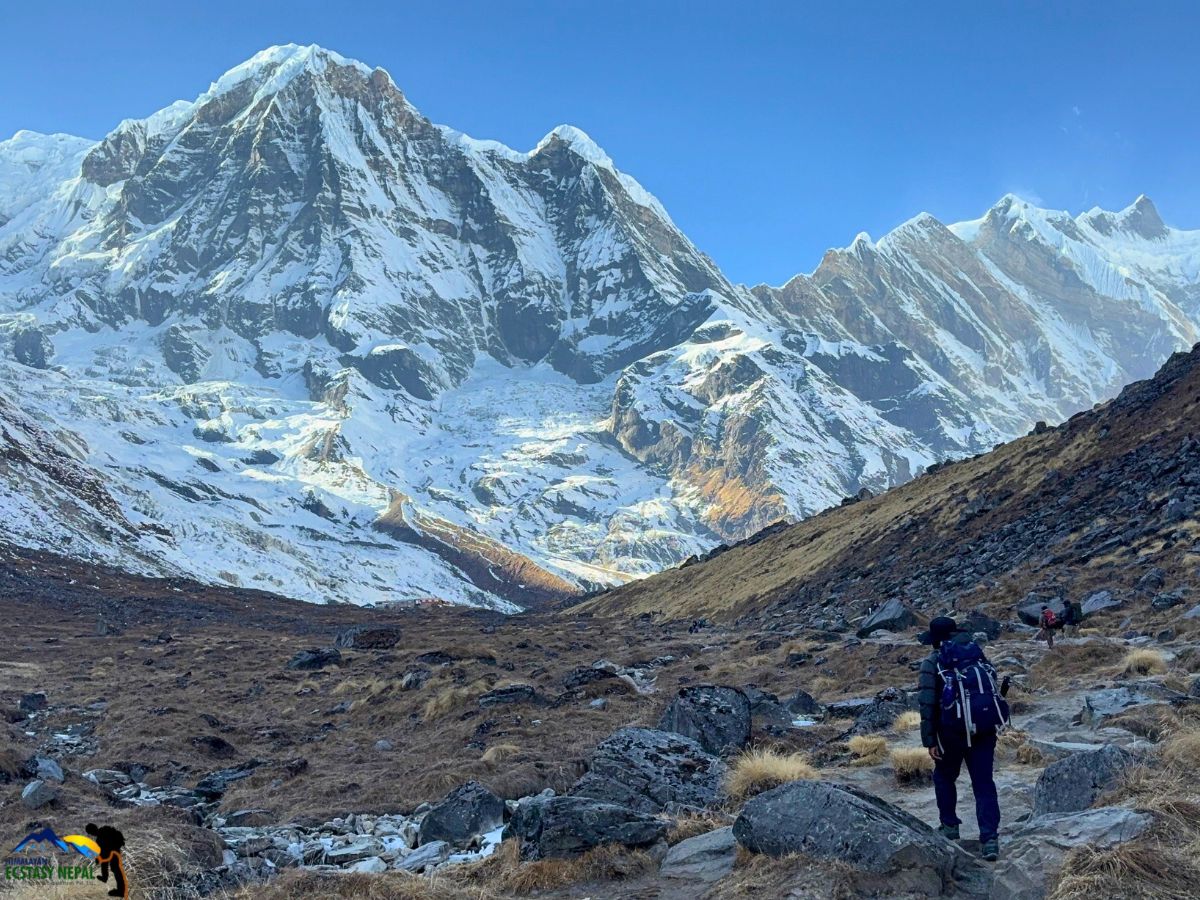
On the way to Annapurna Base Camp from Machhapuchhre Base Camp
A Typical Trekking Day
Most days start with an early breakfast and a start on the trail soon after.
You walk for three to four hours, stop for lunch at a lodge, then walk again until mid or late afternoon. Dinner is early, and most trekkers are asleep soon after.
Transport and Helicopter Return
Airport transfers on arrival and departure are by private vehicle. On Day 3, we collect you from your Pokhara hotel and drive you to Nayapul.
Between Kathmandu and Pokhara, you can fly, which takes about 25 minutes, or go by road, which takes roughly 6 to 8 hours.
For the road, you can choose a private vehicle or a tourist bus, and a local sharing jeep or public bus is cheaper (just mentioning, not part of the package). The flight and the choice of vehicle change the price, so tell us what you prefer when you book!
We base the helicopter in Pokhara. That means it flies to ABC and brings you back to Pokhara after your trek, and you get to spend about20 to 25 minutes in the air.
A direct flight from ABC to Kathmandu is possible but optional, for trekkers with limited holiday time. It costs more, and the aircraft is still based in Pokhara.
Note that helicopters fly only in clear weather. If cloud blocks the flight, we have to wait for a window and it's mostly in the mornings!
Note: We base our helicopter in Pokhara, so the flight from Annapurna Base Camp to Pokhara is the more affordable option. If you have a short holiday, you can choose an optional direct helicopter flight from ABC to Kathmandu instead. The cost varies depending on your flight destination and arrangements, so please contact us for the final price.
The Reserve Day
Day 9 is kept free so a weather delay does not break your plans. If everything runs on time, you can use it to leave early, see more of Kathmandu, explore around Pokhara or go for an extension trip to Bandipur, Chitwan, or both!
Because delays can happen, we suggest not booking your flight home before Day 10!
Safety Guide Support
The route is planned around slow height gain. Dovan to Deurali is one steady stage so your body can adjust before you reach the Annapurna Sanctuary.
On Day 7, we stop at MBC for lunch and an AMS check before the last climb. The full steps are in the itinerary (so, kindly read taking time)!
Your guide sets the pace, watches the group each day, and decides when to stop or go down. We carry a first aid kit for you as well as our staff, with bandages, antiseptic, blister plasters, pain relief, rehydration salts and basic medicines.
In case you become sick or hurt, the guide checks on you and calls our office. Mild cases rest or go down to a lower village, and serious cases are evacuated by helicopter.
The evacuation steps are:
The guide checks the person and calls our office.
Our office contacts the insurance company and arranges a helicopter.
The person is flown to Pokhara, to the hospital your insurer prefers.
Simple habits help your body at height:
Drink three to four litres of water a day.
Walk slowly, no need to rush or try catching another trekker ahead of you.
Eat well and wash your hands before meals.
NTC and Ncell data services work in many villages but not everywhere, and the signal drops higher up. Where there is none, your guide uses a lodge phone or Wi-Fi, or sends a runner to the nearest village with signal.
Moreover, this is a lodge-based trek, not a remote wilderness camping trip. You sleep in proper teahouses or mountain lodges and pass well-settled places on most days.
Why Trek With Himalayan Ecstasy Nepal?
The Annapurna Sanctuary is a high-altitude lodge trek, and the helicopter flight out adds one more thing that has to go right. Here is how we handle it on this route.
Experience on this trail: Our team has trekking and expedition experience since 1997. We know the Annapurna route well, from the stone steps above Ghandruk to the cold nights at Deurali and ABC.
Guides you can rely on: Our guides are licensed, experienced and first aid trained, and they speak English. On Day 7, your guide runs the rest and AMS check at MBC and decides whether the group goes on to ABC.
Clear communication: If your English is limited, our guides use simple words and clear gestures, so you always know the plan for the next stretch.
Altitude built into the plan: We keep Dovan to Deurali as one steady stage, then stop at MBC for lunch before the final climb. This gives your body time to adjust before ABC at 4,130m.
A helicopter we arrange ourselves: We base the helicopter in Pokhara and book it ourselves, so the flight from ABC to Pokhara is short and affordable. If you have limited holiday time, we can arrange the optional direct flight to Kathmandu instead.
Porters who are looked after: Our porters are insured, carry 18 to 20 kg shared between two trekkers, get warm clothing for the cold stretches near MBC and ABC, and eat and sleep in the same lodges along the trail.
Hotels at the same standard: In Kathmandu and Pokhara, we choose the best standard available. If a hotel is full, we move you to another of the same category.
A backup when lodges are full: In busy months, we have a dome tent and mattress as a backup, with meals still at the lodge.
Room for weather delays: Day 9 is a reserve day, so a late helicopter does not break your flight home. You can also use it for Pokhara or an extension to Bandipur or Chitwan.
Emergency support: We carry a first aid kit for all staff. If someone becomes sick, your guide calls our office, and we arrange a helicopter evacuation through your insurance.
Main Attractions of This Annapurna Base Camp Trip
Our Annapurna Base Camp Trek with Heli Return combines a huge glacial basin, some of the highest mountains in the world, living Gurung villages and long stretches of forest. Here are the main attractions you will see on this trek.
Annapurna Base Camp (4,130 m)
Annapurna Base Camp sits on a flat stretch of moraine at 4,130 metres, inside a ring of snow peaks.
Annapurna I (8,091 m), the tenth highest mountain in the world, stands on one side, and a French team led by Maurice Herzog first climbed it in 1950 (but used the other North ABC route).
Annapurna South (7,219 m), Hiunchuli (6,441 m), and Machhapuchre (6,993 m) fill most of the rest of the view. The light is best at dawn, when the snow turns pinkand then gold.
Moreover, the lodges are low stone buildings close together, and a short walk around camp gives you new angles on the peaks!
Machhapuchhre Base Camp (3,700 m)
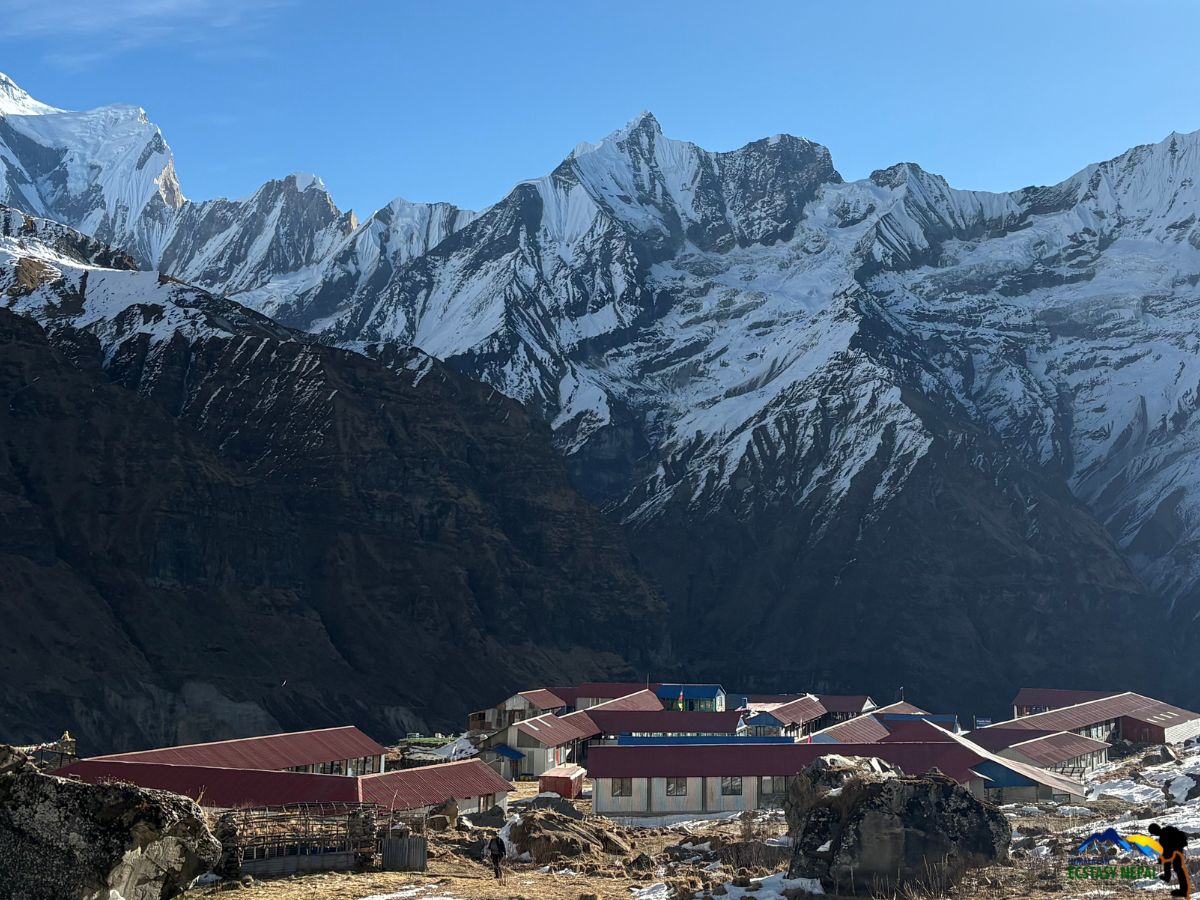
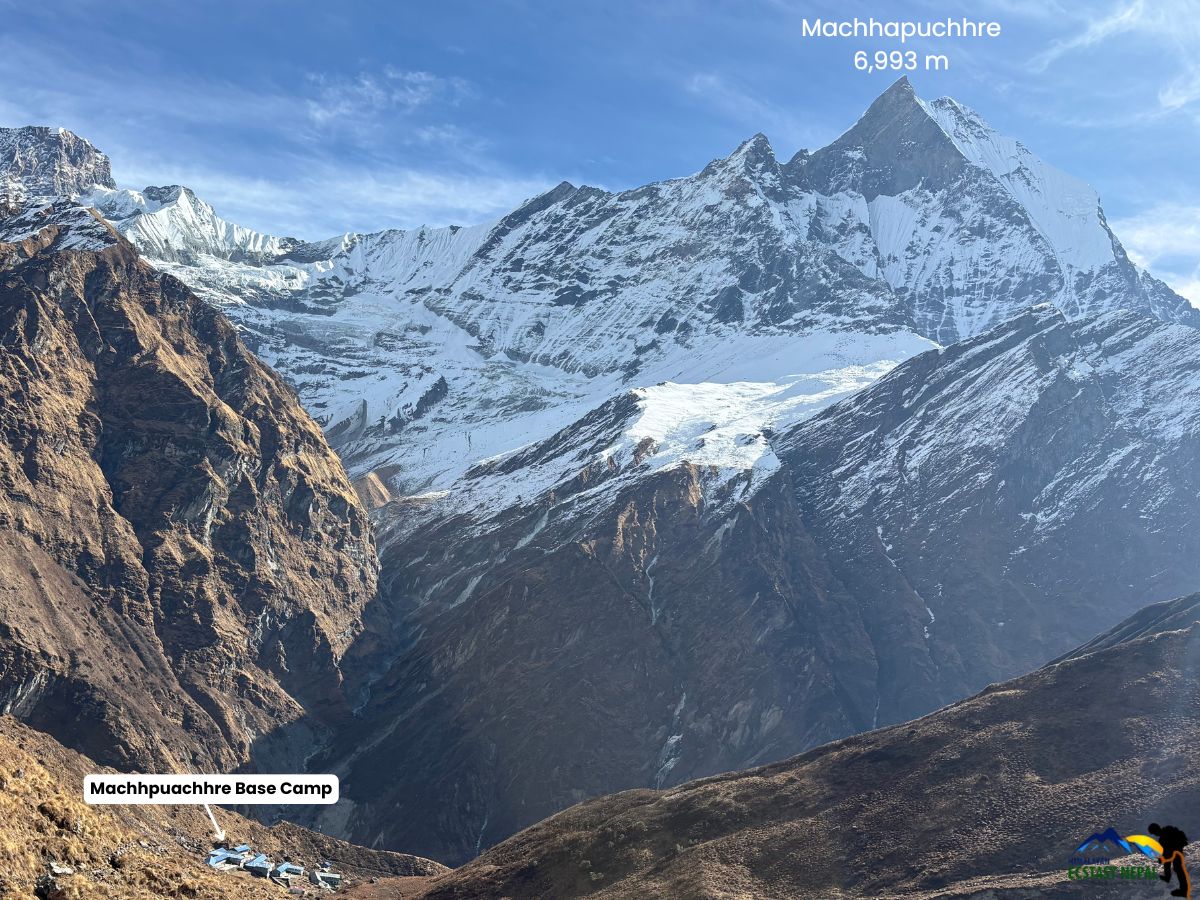
MBC is a small cluster of lodges below the south face of Fishtail.
The mountain looks very close from here, and its twin summit is easy to see. During the sunset, the face of Fishtail catches the sunlight and turns golden!
The slopes above the lodges carry fresh snow for much of the year. It is also the last settlement before the open ground leading to ABC.
Machhapuchhre (Fishtail, 6,993m)
Fishtail or Machhapuchhre gets its name from its twin summit, which looks like the tail of a fish. From Pokhara, it looks like a pointed pyramid over the lake, but as you walk closer, the peak splits into two points.
Many local people link the mountain with the god Shiva.
A British team stopped about 50 metres below the top in 1957, and the summit has been closed to climbers since. Because it guards the gate of the Annapurna Sanctuary, you see it from many points along the trail and serves as the major highlight.
Annapurna South and Hiunchuli
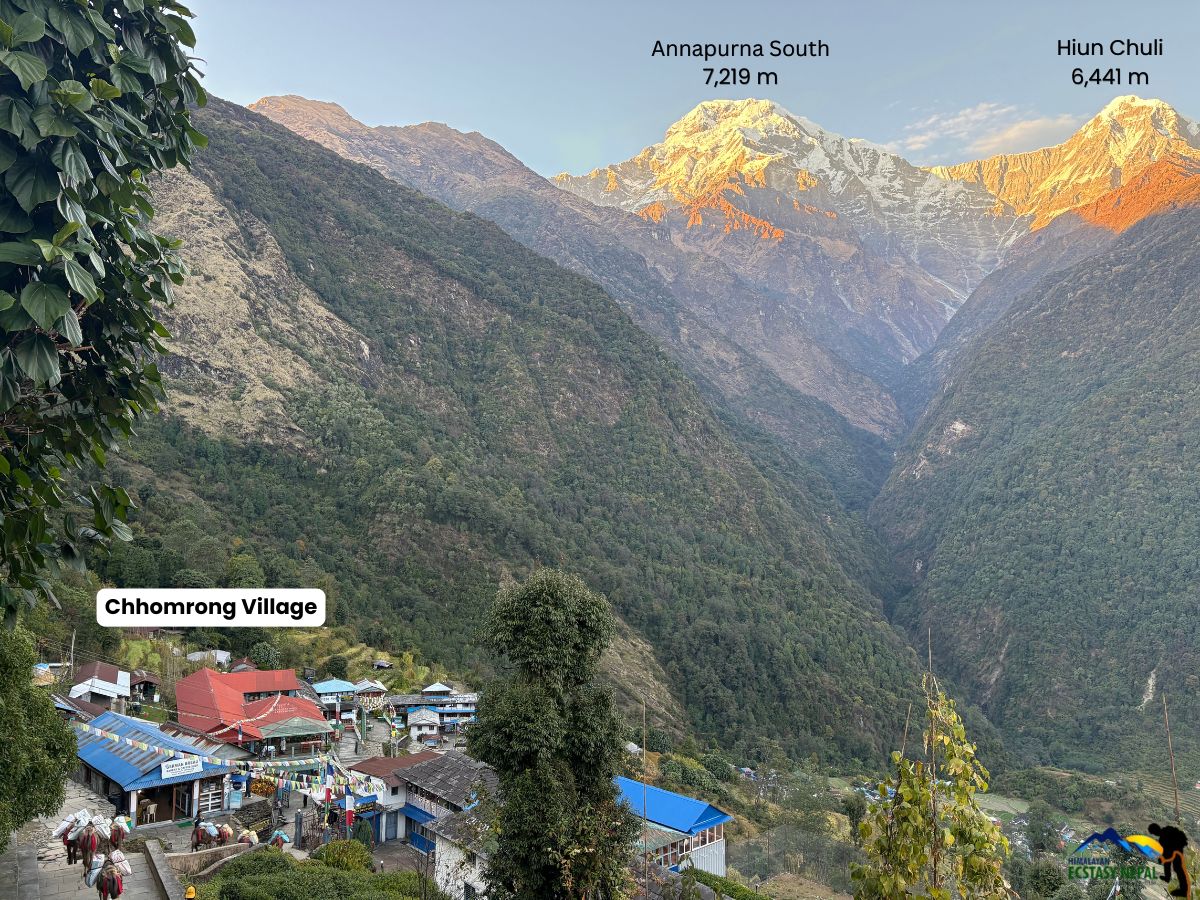
Annapurna South (7,219m) and Hiunchuli (6,441m) rise above Ghandruk and Chhomrong long before you reach the Sanctuary.
Hiunchuli's rounded summit sits next to the sharper ridge of Annapurna South. On clear mornings, both catch the first light from the village terraces.
At the gateway, above Deurali, they stand on one side of the gap, with Fishtail right behind. By ABC, they have grown into the high walls of the basin!
The Modi Khola and the Annapurna Conservation Area
The Modi Khola is the river you follow for most of the walk. It rises in the Sanctuary and runs down through steep forested gorges, and you cross it on suspension bridges.
The whole route lies in the Annapurna Conservation Area, which was set up in 1986. The forest is home to langur monkeys, deer and the colourful Himalayan monal, Nepal's national bird.
In spring, the rhododendron, Nepal's national flower, turns the lower slopes red and pink.
108 Waterfalls and Pojenhyam Baraha Temple
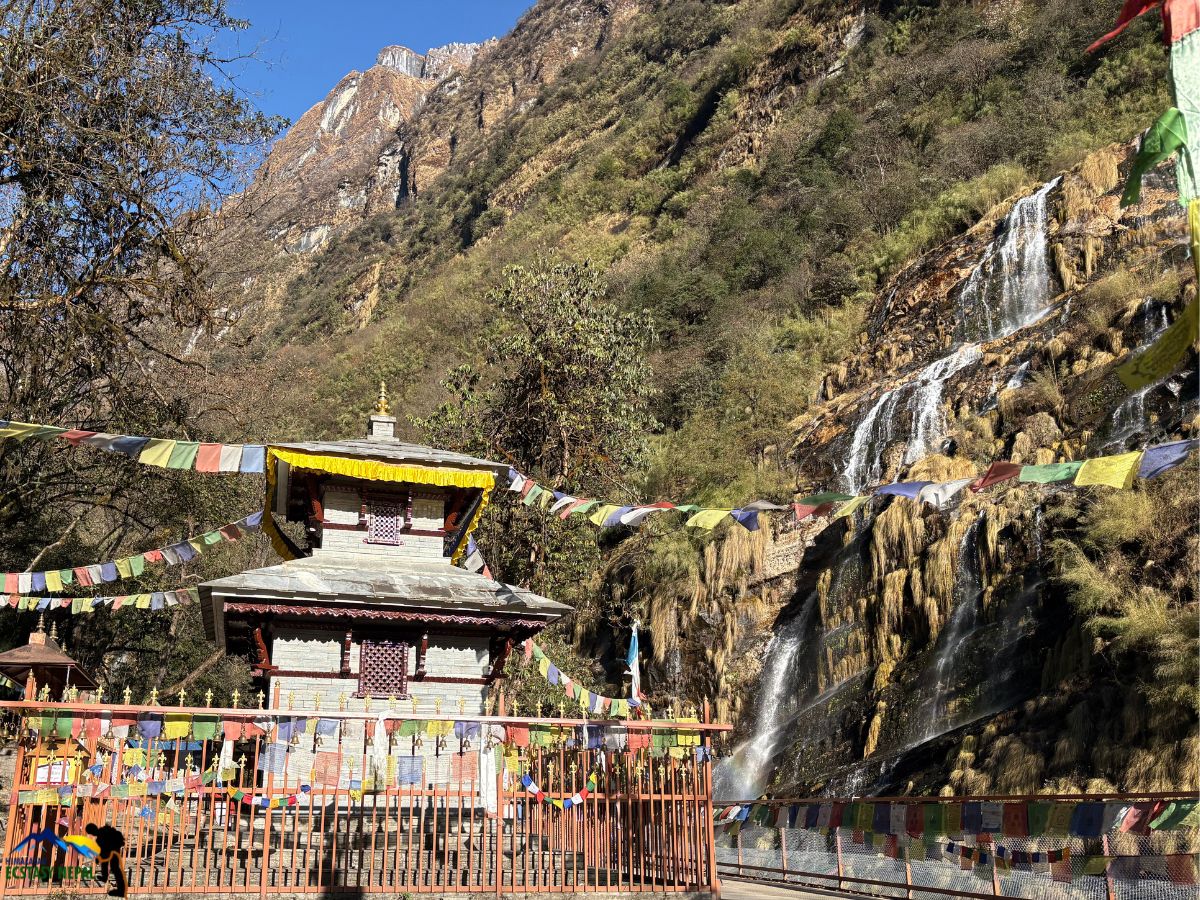
Above Dovan, the trail reaches 108 Chahara, a wall of small waterfalls that pour down the rock beside the path.
The name means 108 streams, and the water comes from the melting glaciers of Annapurna and Gangapurna.
Right next to the falls stands the Pojenhyam Baraha Temple, a Shakti Pitha that is sacred not just to Hindus but also Buddhists. Local people treat the place with great respect, so please do not spit or leave litter near the temple.
You pass it on Day 6, between Dovan and Himalaya, and it is one of the best photo stops on the route!
Gurung Villages and Culture
The Gurung people call themselves Tamu, and their villages on this trail are some of the most welcoming in Nepal.
Many follow a mix of Buddhism and older shamanic traditions, and their biggest festival, Tamu Lhosar, falls in winter.
Their houses are built from stone and slate, and many have wooden verandas facing the valley. Many young men from the villages have served in the British and Indian armies, and the money they send home has helped build schools and lodges (including here in the ABC trail).
Staying in family-run lodges gives you a close look at daily life that you will not get on a wilderness route.
Bamboo and Rhododendron Forest
Between Chhomrong and Deurali, the trail climbs through bamboo and then moss-covered rhododendron forest. Thick moss covers the tree trunks, and light comes through the leaves in thin beams.
The river runs below the path, and its sound follows you for hours. In spring, the blooms add red and pink to the green, and in the colder months the forest is dark and quiet. Above Deurali, the trees fade into rock and snow.
Places Along This ABC Route
The trail passes through towns, farming villages and forest stops that make the walk worth every step. These are the places you pass, in order from the start of the trek.
Pokhara and Phewa Lake
Pokhara sits at about 822 m beside Phewa Lake, and on a clear day Machhapuchhre and the Annapurna range rise straight behind it.
The lakeside has cafes, boat rentals and shops where you can fix any last gear problem. On the water, the Tal Barahi Temple stands on a small island that you can reach by rowing boat.
On the hills above town, Sarangkot and the World Peace Pagoda are popular spots for views of the range. You also come back here at the end of the trek, when it is a good place to rest.
Nayapul and Birethanti
Nayapul is a small roadside town where the road ends and the trail begins. Thisi is also the last stop where ATMs are available.
Birethanti, a short walk upstream, is a busy village where the Modi Khola and the Bhurungdi Khola meet. Stone-paved streets, tea shops and a suspension bridge make it a pleasant place to stretch your legs.
Your permit is checked at Birethanti before you start climbing. Behind the village, the first terraces and stone steps of the Sanctuary trail begin!
Syauli Bazaar and Kimche
Above Birethanti, the path climbs past small settlements such as Syauli Bazaar and Kimche. Terraced fields, stone steps and small streams fill this part of the trail.
You pass farmers working the terraces and women carrying loads of fodder and firewood. These small scenes of daily life make this trek richer than a walk through empty wilderness.
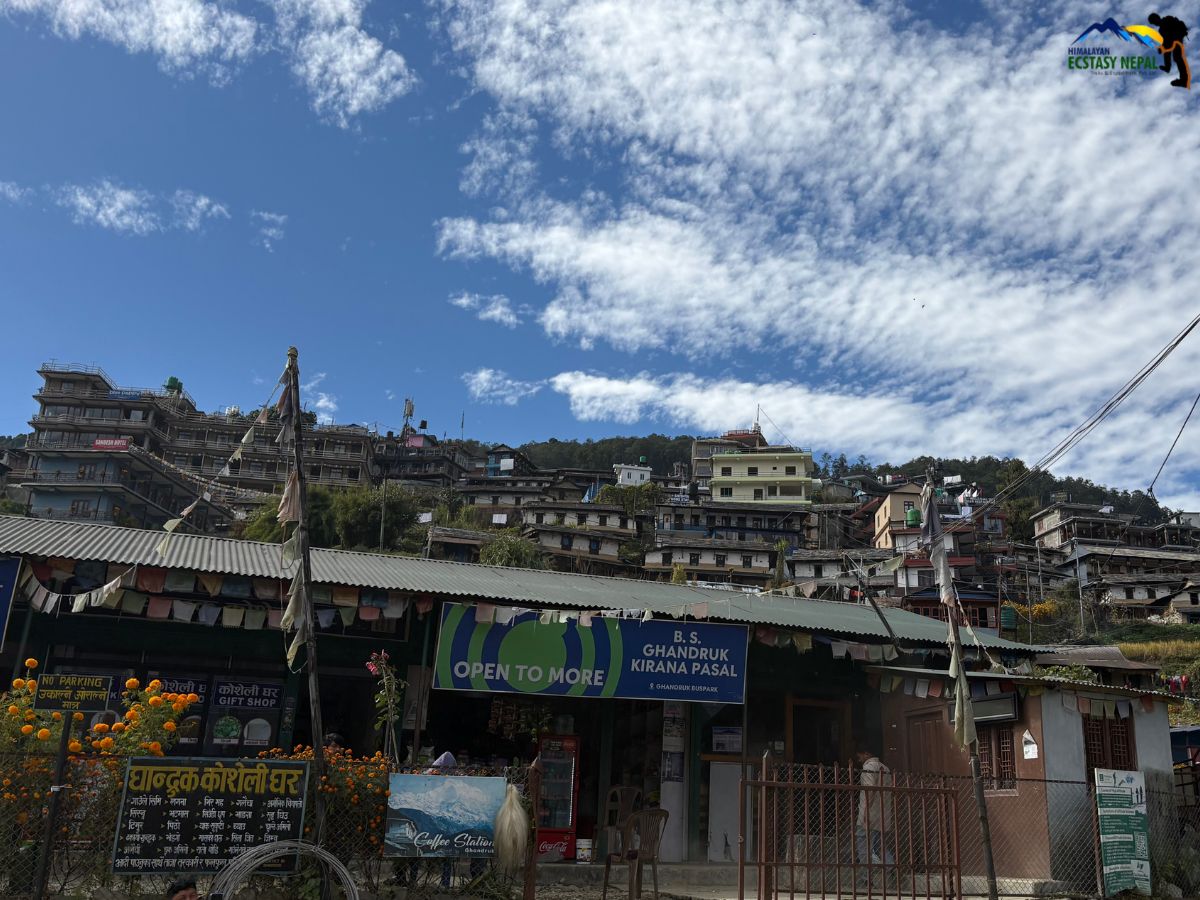
Ghandruk (1,940 m)
Ghandruk is one of the largest Gurung villages in Nepal. Stone-paved lanes run between the houses, and terraced fields of millet, maize and rice step down the hillside.
A small Gurung museum in the village shows local life, and many families take in trekkers in their homes. The view takes in Annapurna South, Hiunchuli and Machhapuchhre in one wide line. It is one of the best places (also a trending one) on the trek to watch the evening light on the peaks!
Kimrong Khola
After Ghandruk, the trail drops steeply to the Kimrong Khola, a fast river that you cross on a bridge.
The climb out of the gorge on the far side is long, and it brings you onto the ridge leading to Chhomrong. This stretch changes all the time, with forest, farm terraces and open slopes in turn. It is the part of Day 4 where most trekkers first feel their legs working!
Chhomrong (2,170 m)
Chhomrong clings to a ridge, with a stone staircase running through the village. It is the last large settlement before the Sanctuary, and lodges get simpler beyond it.
The village is a busy stop, with small shops, bakeries and lodges built into the hillside. Annapurna South and Fishtail face the village across the valley. Looking back the next morning, you can see the whole valley you have walked up!
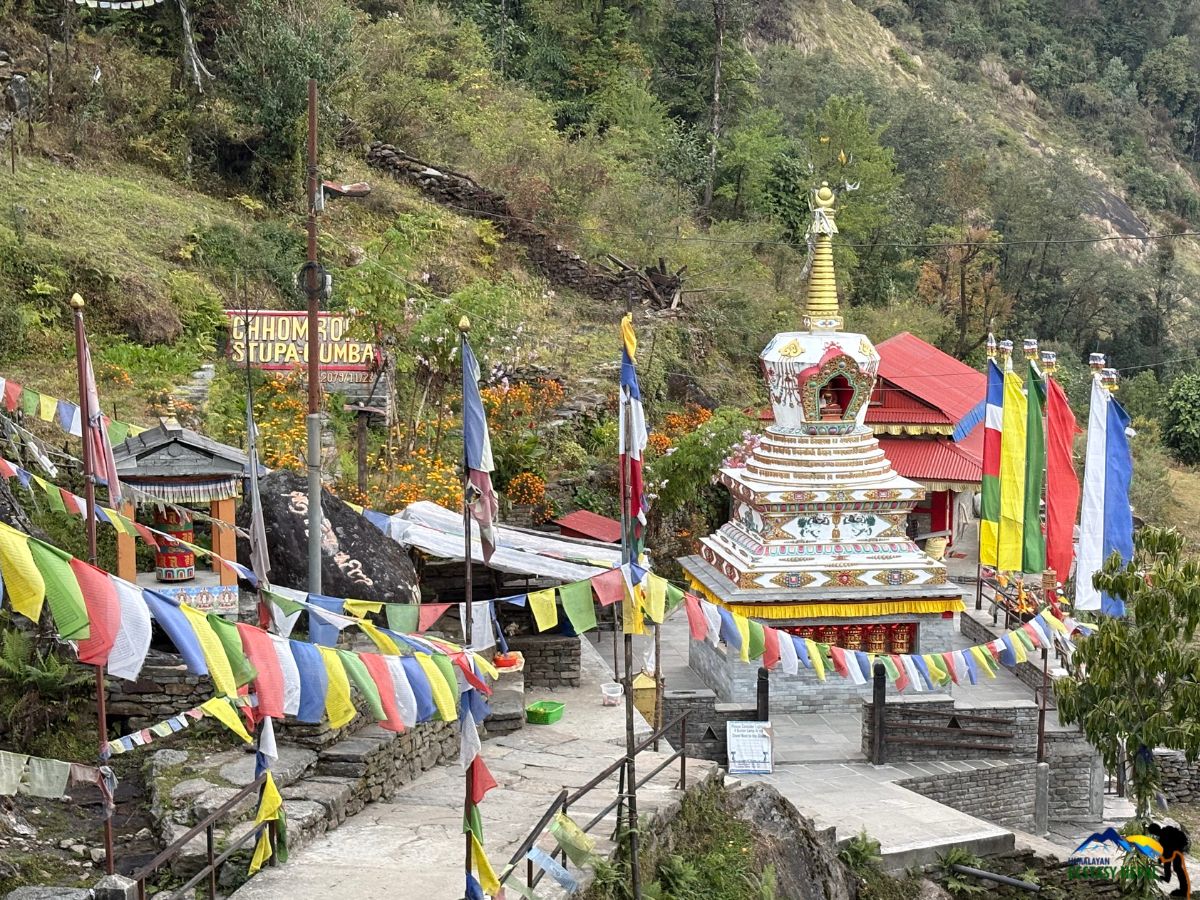
Gumba in Chhomrong
Sinuwa and Bamboo
Past Chhomrong, the trail climbs to Sinuwa, a small ridge settlement, and then enters the forest at Bamboo. The name comes from the thick bamboo groves that shade the path.
The trail here is steep and quiet, with few buildings between the villages. In the monsoon, the forest is wet and full of leeches, while in the dry months it is cool and shaded. It is one of the calmest parts of the walk!
Dovan (about 2,600m) and Upper Dovan
Dovan is a small stop with a few basic lodges set in thick forest. The river runs close by, and you can hear it all night.
Nights here are colder than in Chhomrong, and the mornings are often misty. It is the last place where you sleep among tall trees.
You have two options - Dovan or Upper Dovan, both are like 10 minutes apart.
Himalaya
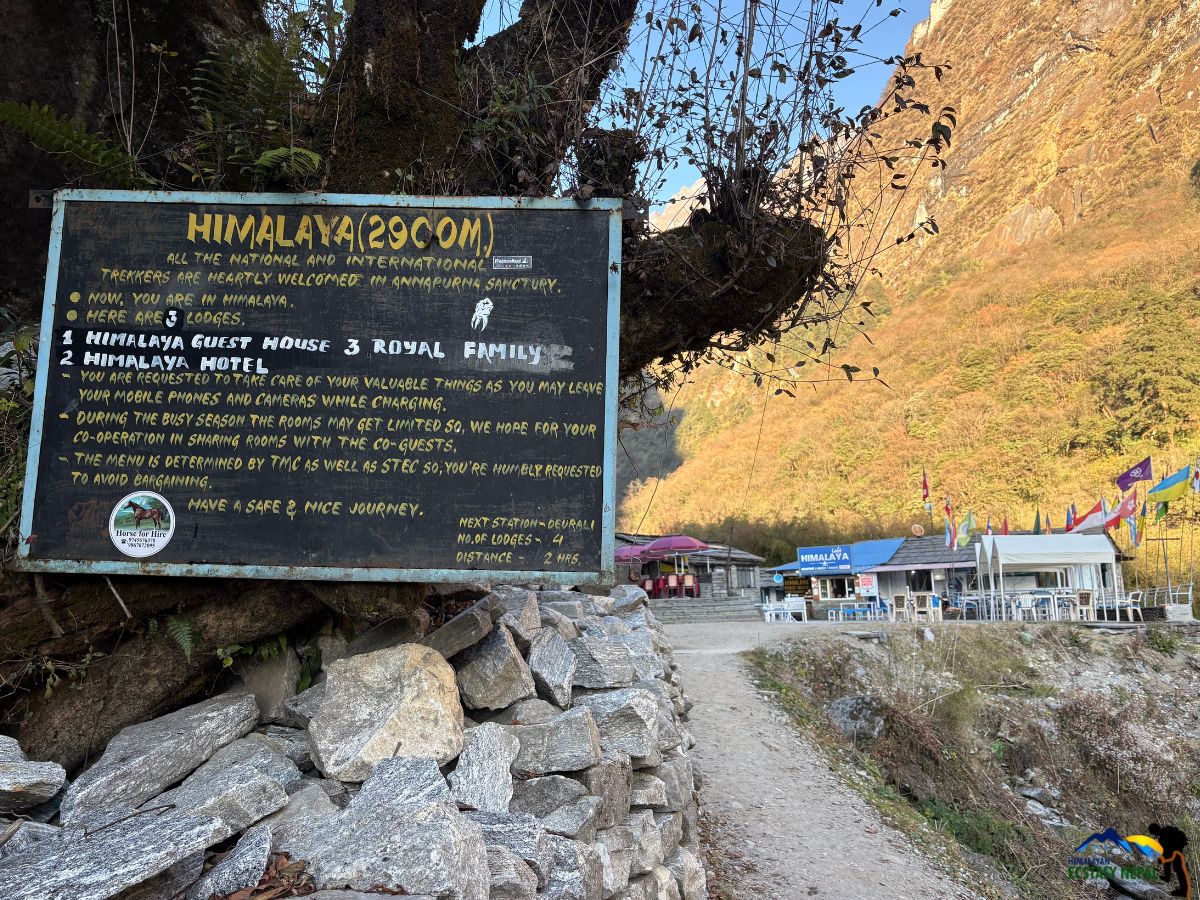
Himalaya is a small cluster of lodges roughly halfway between Dovan and Deurali. It is a common tea/cofffee stop, and the forest around it is thick with rhododendron and moss.
From here, the trees slowly get shorter and the air gets cooler. Many trekkers stop for a hot drink before the steeper section to Deurali!
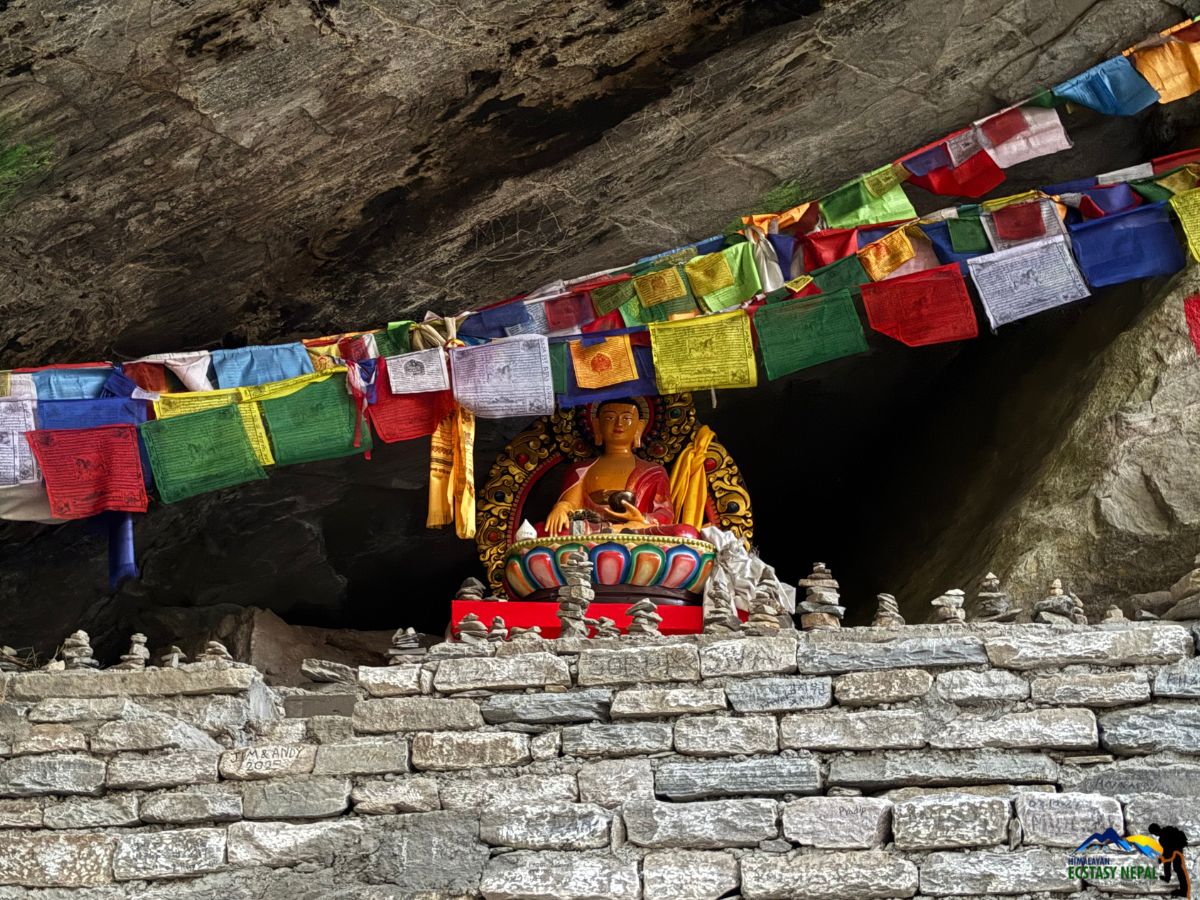
Hinku Cave
Hinku Cave is a rock shelter beside the trail, between Himalaya and Deurali. It is a natural shelter where travellers can wait out rain and snow.
The cave sits in a damp section of forest with moss, ferns and the sound of the river below. Many trekkers stop here for a short rest and a photo.
Note: The part of the trail close to Hinku Cave is also popular by the name "Hinku River", although it's the same Modi Khola. After heavy snowfall, this region is prone to avalanches, so please be careful when crossing here. Stick with our guide and he/she shall lead you!
Buddha statue in Hinku Cave
Deurali (3,230m)
In Nepali, a deurali is a high point or pass on a trail, often marked with a small shrine or pile of stones.
On the ABC trail, Deurali is the last stop before the gateway and the open ground above. A few lodges sit close together, and nights are cold. The last of the forest is just below the village!
Bagar
Beyond Deurali, the trail passes a small stop called Bagar before reaching MBC. The forest is gone here, and the ground is open grass, rock and snow!
Wind picks up in the afternoon, so keep a warm layer within reach. The peaks on both sides now look very close! The gorge here is narrow, and the walls are steep and covered in loose rock and snow.
Small waterfalls drop from the slopes, and the path follows the river over stones and short wooden bridges.
CHITWAN and BANDIPUR TRIP EXTENSION
Each option below is optional and costs extra. We can customize your itinerary based on your interests and available time.
Bandipur
Visit a traditional Newar hilltop town at approximately 1,000 m.
Walk through its historic bazaar, explore traditional brick and wood houses, and enjoy Himalayan views on clear days.
A peaceful stop between Kathmandu and Pokhara.
Chitwan Jungle Safari
Explore Chitwan National Park, a UNESCO World Heritage Site in Nepal’s southern lowlands.
If you prefer to trek back down instead of taking the helicopter, see our Annapurna Base Camp Trek instead.
Annapurna Base Camp Trek with Heli Return - 10 Days Itinerary
Kathmandu to KathmanduExpand all
Welcome to Nepal! A member of our team meets you at Tribhuvan International Airport and takes you to your hotel. We choose the best 3-star hotel available for your dates. If it is full, we use another of the same category!
After you check in, rest or walk around Thamel. Later, our guide or trip coordinator gives you a short briefing about your upcoming trip in Nepal.
We go through the route, check your passport details for the permit, and answer all your questions. This is also a good time to look over your gear, since shops in Thamel can fill small gaps like gloves, socks or poles.
Keep the evening easy because the next day starts with a long travel leg. Dinner is not included, so you can choose any local restaurant!
Max Altitude: 1,400 m Accommodation: 3-star hotelTransportation: Private vehicle for hotel transfer
Today, you travel from Kathmandu to Pokhara by road or by a short flight. We arrange whichever you choose. Just let us know in advance and note that the price varies accordingly.
The drive follows the Trishuli and Marsyangdi river valleys and passes small towns along the highway. The flight is faster and gives you mountain views on a clear day.
Pokhara is the base for the whole trip, and our helicopter is based here too. After you check in, the afternoon is free!
You can walk beside Phewa Lake and watch Machhapuchhre appear on the skyline. Pack a small day bag for the trail tonight and leave anything extra at the hotel.
Max Altitude: 822 m Meals: BreakfastAccommodation: 3-star hotelTransportation: Private vehicle or flight
After breakfast, we drive from Pokhara to Nayapul, the start of the trail. Your guide meets the porters and arranges the permit checks at Birethanti.
Then, you start walking along the river and climb through terraced fields and small hamlets. The last part is a long stone staircase up to Ghandruk.
You stop for lunch on the way and reach the village in the afternoon. The climb can feel steep if you are not used to steps.
Ghandruk is a large Gurung village with stone houses and neat lanes. Walk around once you have rested.
On a clear evening you may see Annapurna South and Hiunchuli above the roofs. Walking time is about 5 to 6 hours!
Max Altitude: 1,940 m Meals: B, L, DAccommodation: Mountain LodgeTransportation: Private vehicle
This is a long and varied day. You leave Ghandruk, follow the ridge, then drop down to a river and climb again!
Most of the ups and downs are stone steps, so poles help. There are forest sections, small tea stops, and wide views across the valley!
Your guide keeps a steady pace and picks a good lunch stop. In the afternoon, you climb into Chhomrong.
The village sits on a ridge facing Annapurna South and Fishtail. It is the last big village before the Sanctuary, so food choices are wider here.
Drink plenty of water and rest well. From tomorrow, the lodges get simpler and the height begins to matter. Walking time is about 6 to 7 hours.
Max Altitude: 2,170 m Meals: B, L, DAccommodation: Mountain Lodge
From Chhomrong, the trail drops down a long staircase. Then, it climbs again through Sinuwa and Bamboo into thick forest.
The path is shaded and cool, and you hear the Modi Khola below. You pass small lodges where you can stop for tea!
The walk is about 5 to 6 hours. The forest can be wet and slippery, so go slowly on the steps.
Dovan is a small stop with basic lodges.Nights are colder than in Chhomrong.
Eat well, drink water throughout the afternoon, and sleep early. Tomorrow is the key stage for acclimatization!
Max Altitude: 2,600 m Meals: B, L, DAccommodation: Mountain Lodge
We go from Dovan to Deurali in one planned stage because it gives you a steady gain and helps your body adjust. The walk takes about 3 to 4 hours.
The trail passes Himalaya and the area near Hinku Cave. The forest thins as you rise and the views open up!
Walk slowly and tell your guide at once about headaches, nausea, or strange tiredness. Early signs are easier to manage than late ones!
Deurali has a few lodges close together, and nights are cold. The dining hall is the warmest place!
Wear warm layers by late afternoon and eat as much as you can. Go to bed early because tomorrow is the big day as you reach the Annapurna Base Camp.
Max Altitude: 3,230 m Meals: B, L, DAccommodation: Mountain Lodge
You leave Deurali and walk through the gateway between Hiunchuli and Machhapuchhre. The first stop is Machhapuchhre Base Camp (3,700m).
At MBC, we stop for lunch and spend a couple of hours there. During this time, our guide checks every trekker for signs of AMS.
If everyone is well, we move on to ABC. If someone is not, we decide on the safest plan for that person, which may mean going down.
The last section is not steep, but the height makes it slow. The whole day takes about 5 to 6 hours.
You reach ABC in the afternoon, and the heart of the Annapurna Sanctuary opens up around you. Don't miss the sunset as it's one of the best moments of the entire trip. Wrap up warm and try to wake before sunrise.
Max Altitude: 4,130 m Meals: B, L, DAccommodation: Mountain Lodge
Get up early for sunrise on Annapurna I and the peaks around the basin. After breakfast, take a short walk around the base camp and enjoy the quiet!
Then, the helicopter arrives. The flight to Pokhara takes about 20 to 25 minutes, and we base the helicopter in Pokhara to keep it short and affordable.
If you have limited holiday time, you can choose the optional direct flight from ABC to Kathmandu. The cost is higher, though!
Flights depend on weather and visibility, so we confirm the timing on the day. Once you land, we take you to your hotel for a hot shower and a good rest. The afternoon is free for you to explore on your own!
Max Altitude: 4,130 m Meals: B, L, DAccommodation: 3-star hotelTransportation: Helicopter and private vehicle
This day protects your plan if weather delays the helicopter. It also gives you choices if everything ran on time!
If you are already in Kathmandu, you can depart today or explore the city.
If you are in Pokhara, you can stay and visit nearby places, or drive or fly back to Kathmandu.
As mentioned earlier, you can book one of our Pokhara Cultural Sightseeing Tour and Kathmandu Valley Cultural Tour if you want a guided day!
You can also extend the trip with a short Bandipur visit or a Chitwan jungle safari, or both. This adds 2 to 3 days and we customize the plan for you.
Today is your departure day. Our team takes you to Tribhuvan International Airport based on your flight time.
Before you leave, check your room and keep your passport and tickets in your hand luggage. If your flight is later in the day, you may have time for a last walk in Thamel.
Please tell us your flight time early so we can plan the pickup. If you added Bandipur or Chitwan, your departure shifts by 2 or 3 days and we adjust the transfers.
We hope the Annapurna Sanctuary was everything you wanted. Safe travels!
Meals: BreakfastTransportation: Private vehicle
Trip Cost Details
Includes
Airport transfers on arrival and departure by private vehicle
3-star hotel in Kathmandu or Pokhara before and after the trek
All food and accommodation in local tea house lodges (B, L, D) during the trek, with tea, coffee and fresh fruits
Annapurna Conservation Area Permit (ACAP)
Licensed, English-speaking trek guide during the trek
Insurance for your guide and porter during the trip
Porter for your baggage (18 to 20kg per porter), at a 2:1 ratio
Duffel bag (returnable) and company t-shirt
First aid kit box for all staff
All ground transportation listed in the itinerary, including the drive from Pokhara to Nayapul
Helicopter charter from Annapurna Base Camp to Pokhara
Excludes
International flight tickets and Nepal entry tourist visa fee
Personal travel and health insurance covering emergency evacuation
Meals when you are in the main cities or outside the itinerary
Hot showers, Wi-Fi and battery charging fees on the trail
All drinks, such as soft drinks, bottled water, beer and whiskey, plus bar bills and desserts
Your personal expenses and toiletries, including laundry
Extra personal porter, if needed (extra cost per round trip)
Your personal warm clothes for the trek
Optional direct helicopter flight from ABC to Kathmandu
Kathmandu to Pokhara flight, if you choose to fly instead of drive
Bandipur and Chitwan extensions, and extra sightseeing tours
Extra costs caused by natural disasters, political issues, road blockages or anything beyond our control
Early departure from the trip, whether by choice or not, is non-refundable
Tips for guides and porters
Any service not listed under Includes
Note: If you need extra days beyond the planned itinerary, the extra days are charged by the day. The price depends on several factors, so please ask our team for the daily rate.
Trip Gallery
See More
Essential Information
Best Time to Trek
Spring and autumn are the best seasons for this trek. March, April, May, October and November give the most stable weather and the clearest views!
Spring brings blooming rhododendron in the lower forest and warmer days, and mornings are usually clear. By afternoon, cloud and haze often build, so the best mountain views come early. Late May is warm and hazy, and the views are less sharp with possible light downpours.
Autumn usually brings dry trails, sharp visibility, and steady weather. October and November are the clearest months, but nights at Deurali, MBC and ABC are very cold. Autumn is also the busiest time, so lodges fill up faster and our backup arrangements are used more often.
Here's a month by month comparison:
March: cold nights, clear mornings and the first rhododendron blooms.
April: warmer days, rhododendrons at their best and a busy trail.
May: warm and hazy, with clouds building earlier in the day..
October: usually the clearest month, and the busiest.
November: cold but very clear, with fewer trekkers.
Note: Dashain, usually in late September or October, is Nepal's biggest festival. Buses and flights fill up, and some shops in the cities close for a few days, so plan your travel dates around it.
Winter (December to February) is very cold at ABC, and snow can cover the upper trail. The monsoon (June to August) brings rain, leeches and heavy cloud, and helicopter flights get cancelled more often.
Permits and Regulations
The whole route is inside the Annapurna region, so you need the Annapurna Conservation Area Permit (ACAP). It is included in the package and we arrange it for you!
Currently, ACAP fee for non-SAARC foreign nationals at NPR 3,000, with a lower fee for SAARC nationals. Permits are checked at the checkpoint at Birethanti, as mentioned earlier.
Please do remember to send us a clear copy of your passport and passport photos before you travel. Keep your passport with you on the trail!
On the trail, carry out your plastic waste and do not pick plants or feed wildlife. These are standard rules in the conservation area and you should follow them by heart!
Travel Insurance: Why We Recommend It!
Insurance is separate from the permit. You need personal travel and health insurance that covers trekking up to 4,200m and emergency helicopter rescue.
It's not a legal compulsion for the Annapurna Base Camp Trek but considering the high altitude, we highly recommend to every trekker wishing to book with us!
Your policy pays for any rescue or hospital costs, so check the wording before you buy! That means it must cover your helicopter evacuation, altitude sickness medication, etc.
In fact, we insure our own team (guide and porter) for the whole trip too. If they are being insured, why not you?
ABC Trek Difficulty Explained
Honestly speaking, this is a moderate trek. You walk about 5 to 7 hours a day for five days, mostly on stone steps, and you do not need climbing skills.
The hardest section is Chhomrong to Deurali, where staircases go up and down again and again. Above Deurali, the path eases, but the thin air makes every step slower.
Steps can be slippery after rain, and the upper trail can be icy on spring and autumn mornings. Nights at Deurali, MBC and ABC are freezing as we've been mentioning about it multiple times here!
So, you need to be comfortable walking several days in a row with a small pack. Altitude sickness can affect any trekker, fit or not, so fitness helps but does not replace a slow pace!
Accommodation and Food
During the trip, you will experience a mix of city comfort in 3-star hotels and authentic mountain hospitality in family-run tea houses along the trail. While accommodations become simpler at higher elevations, warm dining halls and freshly cooked meals keep you comfortable throughout the trek:
Hotels: In Kathmandu and Pokhara, you stay in 3-star hotels. We choose the best standard available for your dates, and if a hotel is full, we use another of the same category.
Tea houses: On the trail, you stay in local tea house lodges, usually run by families. Rooms have twin beds with blankets, and bathrooms are shared. Rooms get plainer and colder as you climb. Deurali, MBC, and ABC are the coldest, so a warm sleeping bag or liner matters. Each lodge has a shared dining room, often the warmest room, where trekkers eat and spend the evening.
Busy season: October and April to May are busy, and lodges can fill up. If a lodge is full, our backup is a dome tent with a mattress, and you still eat your meals at the lodge.
Food and drinking water: All meals on the trail are included, with tea, coffee, and fresh fruits. Expect dal bhat, noodles, soup, eggs, pasta and momos, and choose lighter food as you climb because appetite drops with height. Meals are cooked fresh in the lodge kitchens, so choose hot dishes and skip raw salad. Do not drink tap or stream water. Refill with boiled or filtered water at the lodges, which costs a small fee, and use purification tablets as a backup.
Toilets, showers, Wi-Fi and power: Toilets are shared and basic, and some are squat style. Carry your own toilet paper and hand sanitizer. Hot showers, Wi-Fi and charging cost extra at the lodge, and may not work in cold or cloudy weather. Nepal uses 230V power with plug types C, D and M, so bring an adapter and a power bank.
How to Prepare For This Trip?
While the helicopter return skips the downhill walk, the ascent demands solid physical stamina and careful packing for shifting high-altitude conditions. Here is what you need to focus on before you travel:
Physical Preparation: Start two to three months before you travel with stair climbing, hill walking and light jogging. A simple plan is three sessions a week plus one long hill walk of 4 to 5 hours on weekends, raising the time in your last month while carrying your day pack. Daily stamina matters more than speed on this route.
Mental Preparedness: This is a lodge-based trek with simple facilities. Expect cold mornings, shared bathrooms, long days on stone steps and limited comfort at the higher lodges.
Altitude Sickness and Preventive Measures: Learn the early signs: headache, nausea, dizziness, tiredness and poor sleep. Tell your guide at once if you notice any of them, and keep a slow, steady pace.
Hydration and Nutrition: Carry snacks such as nuts or energy bars between meals. Rehydration salts help on long days.
Packing: Pack light, because porters carry 18 to 20kg shared between two trekkers. Aim for about 10kg in your duffel, and keep water, a jacket, snacks and sunscreen in your day pack. Break in your boots before you travel so they do not cause blisters.
Camera and Phone Care: Cold drains batteries fast, so keep them inside your jacket at night. Dawn gives the best light at ABC and MBC, so charge your devices the evening before.
Culture and Documents: Dress modestly in villages, ask before photographing people, and walk clockwise around prayer walls and chortens. Carry your passport, passport photos, insurance papers and some Nepali rupees in cash.
Equipment Lists
The right equipment is essential for a safe and comfortable Annapurna Base Camp Trek. You will experience changing temperatures, cold nights, steep trails, and possible rain or snow as you gain altitude. Pack in layers so you can adjust your clothing to the conditions, and choose comfortable, well-broken-in trekking boots with good grip. Use the checklist below to prepare your gear, clothing, documents, and personal essentials for the journey.
Head
Warm hat that covers your ears
Sun hat or cap
Neck gaiter or buff
Headlamp with spare batteries
Upper Body
Moisture-wicking base layers
Trekking shirts
Fleece or light insulated jacket
Down jacket for MBC and ABC
Waterproof and windproof jacket
Hands
Light gloves
Warm waterproof gloves or mittens
Lower Body
Trekking trousers
Thermal leggings
Waterproof over trousers
Underwear
Foot Wear
Broken-in trekking boots with ankle support
Light shoes or sandals for the lodge
Wool trekking socks and spare pairs
Travel Documents
Passport and spare copies
Passport photos
Travel insurance papers
Nepali rupees in cash
Sun Stuffs
Sunglasses with UV protection
Sunscreen SPF 40 or higher
Lip balm with SPF
Toiletries
Toothbrush, toothpaste and small soap
Quick-dry towel
Toilet paper and hand sanitizer
Wet wipes
Eating & Drinking
Reusable water bottle
Water purification tablets
Snacks such as nuts or energy bars
Sleeping Bags
Sleeping bag liner
Warm sleeping bag for cold nights (bring your own or rent one in Kathmandu or Pokhara)
Bag Packs
Day pack of 25 to 30 litres with a rain cover
Dry bags or plastic liners
Medical & First Aid
Personal medicines
Blister plasters
Pain relief tablets and rehydration salts
Miscellaneous
Trekking poles
Power bank and charging cables
Small padlock
Earplugs
Annapurna Base Camp Trek with Heli Return - 10 Days FAQs
Most visitors need a tourist visa. You can usually get one on arrival at Tribhuvan International Airport, and the fee is not included in the package.
Do not rely on one! Withdraw Nepali rupees in Kathmandu or Pokhara, since you pay for showers, charging, drinks and tips in cash.
You can usually leave spare bags at your Pokhara or Kathmandu hotel while you trek. Ask us when you book so we can arrange it!
Yes. Dal bhat, vegetable noodles, pasta, vegetable momos and egg dishes are easy to find. Tell us about any allergies when you book so we can prepare right food for your trip!
Yes. You can buy an NTC or Ncell tourist SIM at Tribhuvan International Airport or in Kathmandu with your passport.
Avoid it at altitude. Alcohol worsens dehydration and can hide the signs of altitude sickness. Also, note that we do not include alcoholic drinks in this package.
Tips are not included. Many trekkers tip the guide and porters at the end of the trek, and we can help suggest a fair amount at your briefing.
Yes. Many first-time trekkers do ABC. A slow pace and honest reporting of symptoms matter more than past experience.