Island Peak (6,189 m, 27°55′15″ N, 86°56′07″ E) and Lobuche East (6,119 m, 27°57′34″ N, 86°47′24″ E) are two glaciated peaks in the Khumbu region of Nepal, roughly 15 km apart.
Eric Shipton's party gave Island Peak its name because it looks like an island in a sea of ice, and a British team training for Everest reached its southwest summit in 1953. Lobuche East was first climbed on 25 April 1984 by Laurence Nielson and Sherpa Ang Gyalzen.
This 8-day 2 Peak Challenge is our base camp to base camp package. We meet you at Chhukung (4,730 m), train you at Island Peak Base Camp, climb Island Peak first, then move across to Lobuche High Camp (5,400 m) for the second summit.
Licensed climbing guides, fixed ropes, technical gear and 2 contingency days are part of the plan. You can start with either peak, depending on how acclimatized you already are.
Climbing grade: Alpine PD+ (Peu Difficile Plus) for both peaks
Trip Overview
Duration8 Days
Trip GradeStrenuous
Strenuous trips like expeditions to 6,000 m plus peaks, 7,000 m and 8,000 m mountains involve high altitudes, extremely difficult terrain, and very extended durations - need technical climbing skills and use of climbing equipment.
CountryNepal
Maximum Altitude6,189 m
Group Size1 to 10
StartsChhukung (4,730 m)
EndsPheriche (4,371 m), with the option to continue down to Tengboche (3,860 m)
ActivitiesBase Camp to Summit Base Camp Climbing
Best TimeApril to May and October to November
PEAK CLIMBING REQUIREMENTS
Climbing 2 peaks in 8 days asks more of you than a single summit, so the requirements are stricter than on a one-peak climb. Please read each point before you book:
Climbing experience: You should already be comfortable walking in crampons and holding an ice axe, and you should have been above 5,000 m before. Beginners can start with Island Peak, where we train you at Base Camp, but Lobuche East is steeper, and 8 days leaves little room to learn everything from zero.
Acclimatization before you start: Our service begins at Chhukung (4,730 m) and your first summit comes on Day 3, so you need to arrive already acclimatized. A completed Everest Base Camp trek with Kala Patthar, or a two pass or three pass trek, is the best preparation. If you need more time to adjust, we can arrange the walk-in from Kathmandu (see the packages section below).
Fitness: You need to walk 6 to 8 hours a day at altitude with a daypack. Summit days are long, around 12 to 14 hours on Island Peak and 13 to 15 hours on Lobuche Peak when you walk down to Pheriche the same day, so build real stamina for at least 3 months before you come.
Group size: Solo climbers, friends and teams are all welcome, and you can also join a fixed departure date. The price on the website is quoted on the real number of participants, which keeps it feasible for everyone.
Permits: We arrange the climbing permits for Island Peak and Lobuche East from our Kathmandu office. You carry your own Sagarmatha National Park and Khumbu Pasang Lhamu Rural Municipality permits (most trekkers coming off the Everest trail already hold them), or we arrange them for you if you start from Kathmandu with us.
Guide: You climb with our licensed, English-speaking climbing guide and crew from Base Camp upward, and the number of climbing staff depends on your group size (see the table in the overview). You never climb above Base Camp on your own.
Insurance: You need personal travel and rescue insurance that covers climbing up to at least 6,500 m and helicopter evacuation. The insurance we hold for our guide, assistant guides and porters does not cover you.
Medical fitness: Get a check-up before you travel, especially if you have heart, lung or blood pressure problems, and bring enough of your own prescribed medicine.
Advance planning and documents: Tell us at least 3 to 4 days ahead, even if you are already somewhere in the Everest region, because the permits are processed from Kathmandu. Keep a copy of your passport, a passport-size photo and a copy of your insurance ready to send by email or WhatsApp. Saturday is a government holiday in Nepal, so permit work happens on the other days.
PEAK CLIMBING HIGHLIGHTS
Stand on 2 summits above 6,000 m in one short trip: Island Peak (6,189 m) and Lobuche East (6,119 m).
Join the climb straight from the Everest trail at Chhukung, with no separate approach.
Train at Island Peak Base Camp (5,150 m) on crampons, ice axe, fixed rope with a jumar, figure-8 descending and rope safety.
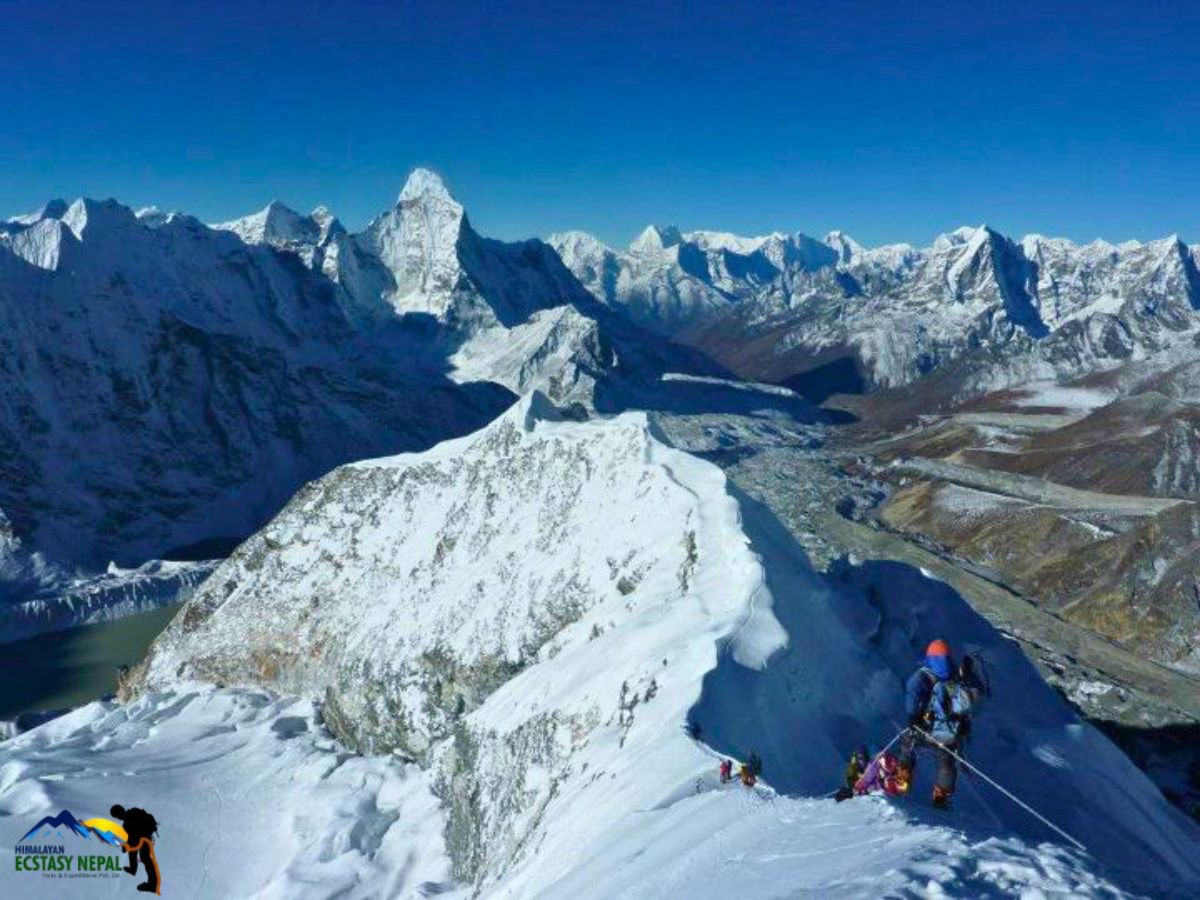
Cross the Imja Glacier and climb the fixed-rope snow and ice headwall to Island Peak's narrow summit ridge.
Sleep at Thukla (4,620 m), just below the pass where memorials to climbers lost on Everest stand.
Sleep at Lobuche High Camp (5,400 m) on a rocky ledge with views toward Cholatse, Taweche and Ama Dablam.
Climb Lobuche East's steep snow headwall and exposed summit ridge on fixed rope.
See Lhotse, Nuptse, Makalu, Ama Dablam and Everest from Island Peak, and Everest, Lhotse, Nuptse, Pumori and Ama Dablam from Lobuche.
Choose your order: Island Peak first if you need extra acclimatization, Lobuche first if you are already acclimatized after Everest Base Camp and Kala Patthar.
Keep 2 contingency days (Day 4 for Island Peak and Day 8 for Lobuche East) in the original itinerary, with additional days available at USD 120 per day if required.
PEAK CLIMBING PLAN
The plan moves in 2 blocks: Island Peak from Chhukung, followed by the walk across the valley to Lobuche High Camp. An early start and a packed lunch are necessary for the walk from Thukla to Lobuche High Camp, as there are no tea houses or lodges along the route.
Day 1: Meet our team at Chhukung (4,730 m), fit your gear and attend the climbing and safety briefing.
Day 2: Walk 3 to 4 hours to Island Peak Base Camp (5,150 m), then train on crampons, ice axe, jumar and rope safety.
Day 3: Summit Island Peak (6,189 m) via the glacier, crampon point and fixed-rope headwall, and return to Chhukung.
Day 4: Contingency day. If weather stops the summit attempt, the team stays at Base Camp for a second attempt.
Day 5: Walk 6 to 7 hours from Chhukung to Thukla (4,620 m) through Dingboche.
Day 6: Start early from Thukla and trek to Lobuche High Camp (5,400 m) via Lobuche Base Camp. Carry a packed lunch, sufficient water and essential personal items in your daypack, as there are no tea houses or lodges along the route.
Day 7: Summit Lobuche East (6,119 m) and return to Lobuche High Camp. Depending on the weather, timing and your physical condition, you may continue down to Pheriche (4,371 m).
Day 8: Contingency day for the Lobuche East summit. If bad weather prevents the summit attempt on Day 7, the team uses this day for another attempt. If the contingency day is not needed, continue descending toward Pheriche or Tengboche, depending on where you spent the previous night.
Note: Additional days beyond the original itinerary are available at USD 120 per day.
Essential High-Altitude Gear and Safety Notice
For a successful 2 peak climb, you need the right high-altitude and technical equipment. With tented nights at 5,150 m and 5,400 m and summits at 6,189 m and 6,119 m, these items decide how warm, safe and strong you feel on summit days.
Insulated Mountaineering Boots: You need insulated boots that fit crampons, for the glacier, the headwalls and the summit ridges. Warm climbing boots are available to rent by foot size, so you do not need to carry them. If you bring your own, make sure you have already worn them on long walks.
Crampons: Crampons are needed from the crampon point on both peaks. HEN provides them, and our guide checks the fit with you at Chhukung and again at Base Camp.
Ice Axe: An ice axe gives you balance and security on snow and ice. HEN provides it and shows you how to hold and use it.
Four-Season Sleeping Bag (-20°C or below): A warm bag lets you sleep at Island Peak Base Camp and Lobuche High Camp. Poor sleep at 5,400 m can weaken your summit push.
Down Jacket and Windproof Outer Shell: Both protect you during the early starts and when the weather changes. Warm down jackets are available to rent by foot size.
Gloves: Bring insulated gloves or mittens together with a thinner liner pair. The liners keep your hands working when you handle the jumar, carabiners and rope.
Climbing Helmet: A helmet is needed on both headwalls, where falling ice and loose rock are a real risk. HEN provides it.
Harness and Ascender (Jumar): You use a harness set with locking and non-locking carabiners and a jumar on the fixed ropes. HEN provides both and trains you at Island Peak Base Camp before the first summit.
Technical Climbing Equipment: HEN provides fixed rope, main rope, harness set, jumar, figure-8 descender, crampons, carabiners, ice screws, rock pitons, ice axe and helmet.
Supplemental Oxygen: Not required at 6,189 m or 6,119 m. Both summits sit well below the altitude where supplemental oxygen becomes necessary, so your preparation matters more than any extra equipment.
PEAK CLIMBING PACKAGES: CHOOSE WHAT WORKS BEST FOR YOU
This is a base camp to summit to base camp package. It covers the technical part only: arrival at Chhukung, both climbs and the walk down to Pheriche, with our climbing guide, camp logistics, food and tented accommodation on the mountain, the peak permits and the other essentials for the 8 days.
Option A: Base Camp to Base Camp (this package). It is our most flexible peak climbing option, made for trekkers who finish a personal trip in the Everest region and want to add 2 summits, individually or in a group, as long as they are already well acclimatized.
Option B: Full arrangement from Kathmandu. If you want one team for the whole trip, we can arrange the same 2 peak climbing from your arrival in Kathmandu and take care of the entire logistics: airport pick-up, hotel, the flight to Lukla (from Manthali in Ramechhap during the busy seasons), the Everest Base Camp trek with Kala Patthar for acclimatization, and then the 8 days on this page. This is also the better choice if you are a beginner who needs extra acclimatization before Island Peak.
Your order: You can climb Island Peak first or Lobuche first, depending on your acclimatization. The overview below explains how to choose. This package does not replace our full-package peak climbing pages, which remain valid. If you would rather have a longer, slower build-up, those pages are still there for you!
8-Day 2 Peak Challenge: Island Peak and Lobuche Peak Climbing
You may have Everest Base Camp behind you already, or you may be planning it, and somewhere along that trail 2 names keep coming up: Island Peak and Lobuche Peak. Most climbers choose one, but the 2 mountains are only 2 days' walk apart, so a lot of trekkers ask whether a single trip can cover both. It can, and this is how we do it!
The 8-day 2 Peak Challenge is our base camp to summit to base camp package for Island Peak and Lobuche Peak Climbing. We meet you at Chhukung (4,730 m), and from that point our team handles the mountainside: climbing guides, fixed ropes, technical gear, tents, camp kitchen and permits. You bring your personal clothing, your insurance and the acclimatization you built on your own trek!
A quick note on names: When this page says Lobuche Peak, it means Lobuche East (6,119 m), which the Nepal Mountaineering Association lists as a trekking peak. Lobuche West (6,145 m) is a separate expedition peak and is not part of this package.
Why 8 Days Is Enough for 2 Summits?
Our base camp to summit to base camp format takes 4 to 5 days on Island Peak, Lobuche Peak or Mera Peak when each is climbed alone, and that figure applies only to those 3 peaks.
Other peaks need 6 to 7 days, because the time on each mountain depends on elevation, technical difficulty, the distance of the summit push, the route and how much fixed line has to be set.
For this package we put 2 climbing blocks back to back and keep 2 contingency days, 1 after each summit attempt, which is how we arrive at 8 days.
Two Peaks, Two Characters
While Island Peak and Lobuche East share the same region and technical grade, each mountain offers a completely distinct climbing experience.
From the glacier-walking and classic headwall of Island Peak to the steep, exposed rock and snow ridges of Lobuche, combining the two gives you the ultimate contrast in high-altitude Himalayan mountaineering.
Island Peak (Imja Tse, 6,189 m)
Island Peak rises from the Imja valley above Chhukung. Eric Shipton's party named it in the early 1950s because, seen from Dingboche, it looks like an island in a sea of ice.
The southwest summit was climbed in 1953 by a British team training for Everest, which included Tenzing Norgay, Charles Evans, Alfred Gregory and Charles Wylie, and the main summit was first reached in 1956 by Hans-Rudolfvon Guntenand 2 Sherpas from a Swiss team.
Nepal officially renamed it Imja Tse in 1983, though the trail still calls it Island Peak.
The climb itself is a glacier and fixed-rope climb, graded Alpine PD+. From Base Camp at 5,150 m you cross moraine, step onto the Imja Glacier and walk a broad snow plain to the crampon point, a ledge at roughly 5,500 to 5,800 m. Then comes the headwall, 100 to 150 m of snow and ice on fixed rope, and a narrow summit ridge above it.
Lobuche East (Lobuche Peak, 6,119 m)
Lobuche has 2 summits joined by a long, deeply notched ridge, and the lower one, Lobuche East, is the trekking peak. Its first recorded ascent was on 25 April 1984 by Laurence Nielson and Sherpa Ang Gyalzen.
It rises beside the Khumbu Glacier near Lobuche village, right above the Everest Base Camp trail, which is one reason Everest expedition climbers often use it as a warm-up.
The standard route is also graded Alpine PD+. It goes from Lobuche Base Camp (about 4,950 m) up rocky slabs to High Camp at 5,400 m, then over rock to the crampon point, across a glacier and up a snow headwall of about 45 to 50 degrees on fixed rope, before an exposed summit ridge.
The 2 peaks suit each other well, because Island Peak gives you glacier and fixed-rope practice and Lobuche asks you to use the same skills on steeper, more sustained ground.
The Trip by Altitude: What You Pass Through
High-altitude climbing isn’t just measured in kilometers or days, it’s felt in every breath as the landscape shifts around you! Breaking this journey down by elevation reveals how the trip naturally unfolds, matching the physical and mental shifts your body experiences step by step.
Above 5,000 m: Where the Climbing Happens
Island Peak Base Camp (5,150 m) sits near Pareshaya Gyab between the Imja and Lhotse glaciers, and it is where the training happens and where tented camp life begins.
From here, you climb to the crampon point, up the fixed-rope headwall and along the ridge to the summit, with Lhotse's south face, Nuptse, Makalu, Ama Dablamand the upper reaches of Everest in view.
Later, Lobuche High Camp (5,400 m) gives you a rocky ledge to sleep on, and the Lobuche summit adds a different angle on Everest, Lhotse, Nuptse, Ama Dablam and Pumori.
Between 4,300 m and 4,800 m: The Trail and the Villages
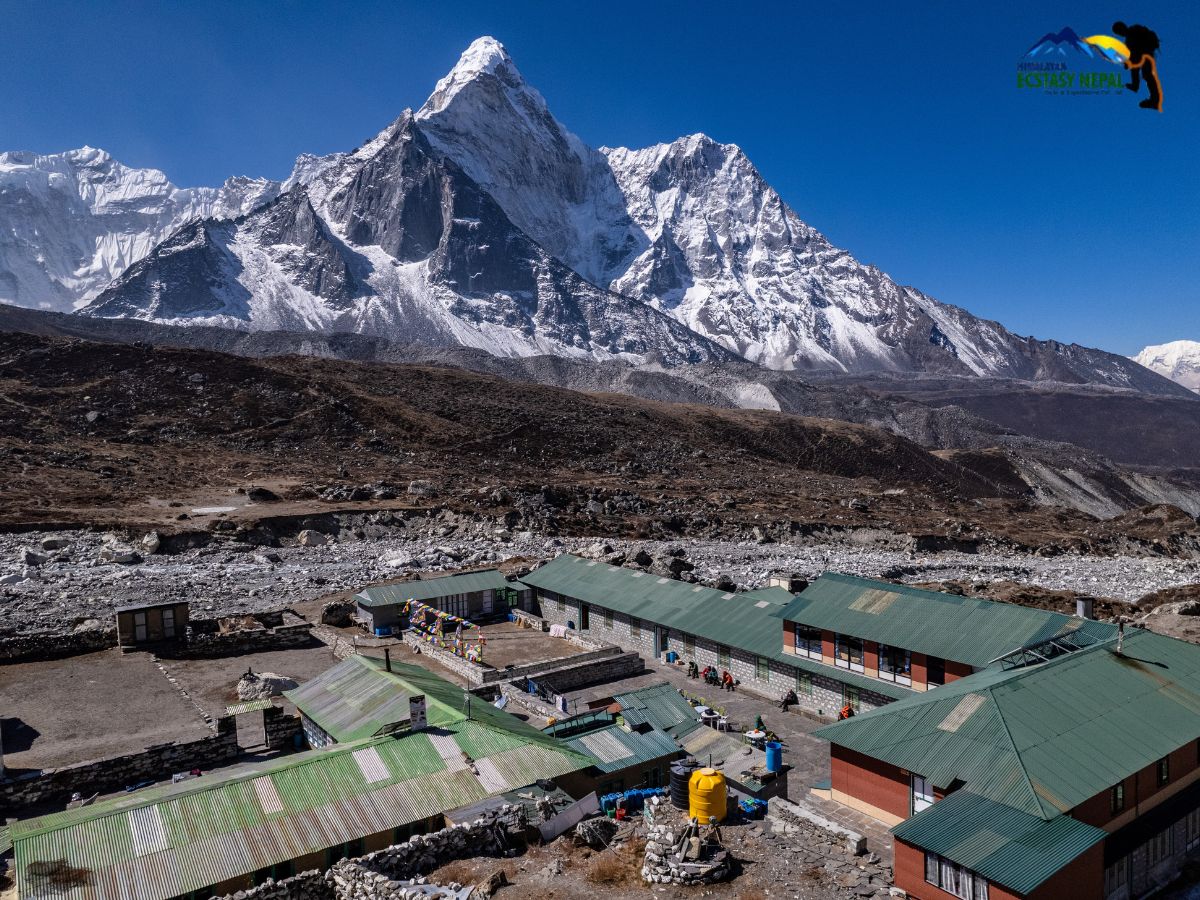
Chhukung Village
Chhukung (4,730 m) is the last village in the Imja valley and the place where Island Peak comes into view. Dingboche (4,410 m) is the farming village you pass on Day 5, with its stone-walled fields and mani walls.
Thukla (4,620 m) is a small cluster of lodges at the foot of the pass where the memorials to climbers who died on Everest stand, and Pheriche (4,371 m) has a seasonal altitude clinic. The lodges here are Sherpa-run, with basic rooms and simple menus, and you sleep in Chhukung, Thukla and Pheriche.
Below 4,300 m: The Way Down
If you continue down after Day 8, the trail leads to Tengboche (3,860 m), the spiritual centre of the Everest region and home to its best-known monastery.
The air thickens as you drop through pine and rhododendron forest, and most climbers sleep better here than they have in a week!
Choose Your Order: Island Peak First or Lobuche First
Climbers arrive in very different shape, so we keep both orders open:
Option 1: Island Peak first (the itinerary on this page). This suits beginners and anyone who needs extra acclimatization. You settle at Island Peak Base Camp (5,150 m), practise on the ropes in the afternoon, and stand on your first 6,000 m summit before you sleep at 5,400 m for Lobuche.
Option 2: Lobuche first. This suits climbers who are already well acclimatized, for example after Everest Base Camp and Kala Patthar. You start with Lobuche, walk across to Chhukung for Island Peak as the second peak, and after the 2 peak challenge you continue down to Tengboche.
Both orders use the same guides, the same gear and the same safety rules, and only the sequence of days changes. When you contact us, just tell us which option you prefer, and we will arrange the food, accommodation and logistics for it!
Built From the Ground Up: How This Package Came About
We designed this short format ourselves, from the grassroots and from long experience. When we assessed what our clients actually wanted, most of them asked for light arrangements and base camp to base camp support, and we have been providing that from early on and have operated these peaks ourselves.
The programme is light, quick, very feasible and priced close to cost with quality service, and it only turns challenging in the last part, on the mountain!
It is an additional option, not a replacement. Our full-package peak climbing packages remain valid, and this version exists for climbers who want to keep their own trek and add a summit.
Some other operators still follow the same approach, keep their margins small and take safety seriously. We say this openly because social media has left many travellers confused about who to go with and where.
Who can join? Well, trekkers, hikers and adventure seekers, individually or in a group, as long as you are already well acclimatized.
It suits a first-time visitor to Nepal who has done a two pass trek, a three pass trek or Everest Base Camp (any one) and now dreams of a peak above 6,000 m, or who wants to do something meaningful in life!
Teams and groups are always welcome, and you can follow a fixed departure date. Even though the climbing is challenging, we keep the programme flexible.
What We Provide on the Mountain?
The technical gear is complimentary for your trip: a harness set with locking and non-locking carabiners, jumar, figure-8 descender, crampons, ice screws, rock pitons, ice axe and helmet, along with fixed rope and main rope.
We also provide the climbing permits for both peaks, a comprehensive medical kit with an oximeter, dome tents with mattresses (twin sharing), a kitchen and dining tent, kitchen equipment, a toilet tent and 3 meals a day with a cup of tea or coffee on camping days.
Your climbing guide is English-speaking, professional, experienced and licensed, and porters carry the climbing items to Base Camp and bring them down to the nearest town of each peak, according to the porter ratio. The guide, assistant guides and porters are insured as Nepal government rules require.
The number of climbing staff depends on your group:
Participants
Climbing staff
1 to 3
1 climbing guide
4 to 6
2 climbing guides and 1 assistant guide
7 to 10
4 climbing guides
If you want a private climbing Sherpa, it costs $290 per Sherpa, including his altitude insurance, food and accommodation. Warm climbing boots and down jackets can be rented by foot size, so you can leave the bulky items at home. Private support staff are also available on request (additional charges apply).
How Booking Works and a Scam You Should Know About
Send a message to our head office on WhatsApp or by official email for authentic, official documentation. Everything is processed from Kathmandu, and once your climbing permit is issued you are eligible to start climbing.
Tell us at least 3 to 4 days ahead, even if you are already somewhere in the Everest region, so that we can arrange the permits and logistics.
Saturday is a government holiday in Nepal, so permits are handled on the other days. Be ready for instant payment, and send a copy of your passport, a passport-size photo and a copy of your insurance through the official email or WhatsApp.
Scam warning: Someone has already taken bookings by claiming to be HEN staff, and some of those customers later came to our real office. Contact only our head office through WhatsApp or the official email, even when you want to pay instantly, and make all payments and bookings only through the head office.
Climbing Clinic for Those Who Want to Learn First
If you have time before the climb, we run a climbing clinic for people who want to learn climbing and its methodology formally.
Sign up at least 1 month in advance so that we can fix a mountaineering instructor for you. We have given this programme special priority since the company began, and the climbers who trusted us were fully satisfied and recommended it often.
The itinerary, programme and curriculum of the clinic are coming soon, and we will brief you personally when you ask.
Safety Comes Before Price!
The price shown on our website works because it is quoted on the real number of participants, which keeps it feasible and effective for each group. Still, please do not choose only on price.
As our CEO puts it, think twice, because safety matters more than price, and an experienced climbing guide will make you feel that during the summit attempt.
Our climbing guides are qualified guides who have summited Everest or climbed above 7,000 m to 8,000 m. If a team member falls sick, we always bring that person down to a safe place to rest while the others continue the summit push.
Why Climb With Himalayan Ecstasy Nepal?
You will be clipped to a fixed rope at 6,000 m, so the people holding the other end matter more than anything printed in a brochure. This is what we put behind the 2 Peak Challenge:
Guides who have been higher than your summit: Every climbing guide is qualified and has either summited Everest or climbed above 7,500 m, and safety comes first in how they work.
Training before the ropes: Our guide teaches ice walking, crampon use, ice axe, jumar and figure-8 at Island Peak Base Camp, so the skills feel familiar before the headwalls.
Gear, ropes and permits sorted: Technical equipment, fixed ropes, tents, the camp kitchen and the peak permits are ours to arrange, so you only bring your personal clothing and insurance.
Flexibility inside a tight plan: You choose which peak comes first, you have 2 contingency days, and you can add a private climbing Sherpa or support staff.
A legacy behind the format: We have run base camp to base camp support from early on, and this programme came from what climbers asked us for.
A real office in Kathmandu: Documentation, permits and payments all go through our head office, so you always know who is operating your climb and who your team will be.
Two summits above 6,000 m, 8 days, and a team that knows both mountains. Hurry up, reserve your seat, and book now!
2 Peak Challenge: Lobuche Peak and Island Peak Climbing - 8 Days Itinerary
Chhukung (4,730 m) to Pheriche (4,371 m), with the option to continue down to Tengboche (3,860 m)Expand all
Your 2 Peak Challenge starts at Chhukung, the last village in the Imja Valley, where our climbing guide and crew meet you at your lodge. If you are walking up from Dingboche after your Everest Base Camp trek, you simply stop here for the night and our service begins from this point.
Over tea, the guide explains the next 7 days, including both routes, camp heights, the weather outlook and the 2 contingency days.
Next comes the gear check, where your harness, crampons, helmet, jumar, carabiners, ice axe, boots, gloves and layers are fitted and adjusted, and anything missing is flagged so it can be rented before you leave (warm climbing boots and down jackets are available to rent by foot size).
The session ends with a safety talk on altitude symptoms, rope rules, the turnaround time and what to do if someone feels unwell. Rest, drink plenty of water and keep any walk short and easy, because tomorrow you gain altitude!
Max Altitude: 4,730 m Meals: B, L, DAccommodation: Local Lodge
The walk from Chhukung to Island Peak Base Camp takes 3 to 4 hours, following the moraine beside the Lhotse Glacier and passing the snout of the Imja Glacier before reaching a flat campsite near Pareshaya Gyab, between the Imja and Lhotse glaciers.
The gain is about 420 m, so walk slowly and let the guide set the pace. Our crew goes ahead and has the kitchen tent, dining tent, toilet tent and dome tents ready, with 2 climbers sharing each tent.
After lunch the guide runs your training session, covering walking in mountaineering boots, crampon technique, ice axe handling, ascending fixed rope with a jumar, descending with a figure-8 and basic rope safety. Pay attention here, because you will use every one of these skills on both peaks.
Dinner is followed by a short summit briefing, and you should be in your sleeping bag early. A mild headache is common at 5,150 m, so tell your guide how you feel at dinner!
Max Altitude: 5,150 m Meals: B, L, DAccommodation: Dome tent
Summit day starts around 1 to 2 am with tea, a light breakfast and a final equipment check by headlamp. The route crosses moraine and steps onto the Imja Glacier, then follows a broad snow plain to the crampon point, a ledge at roughly 5,500 to 5,800 m where you put on crampons and rope up for the crevassed glacier ahead.
Above it stands the headwall, a snow and ice slope of 100 to 150 m at 45 to 60 degrees, which you climb on fixed rope with your jumar, one climber at a time, while the guides manage rope traffic. In some seasons a large crevasse near the top is crossed on a fixed ladder.
A narrow ridge, sometimes only 1 to 2 m wide, leads to the summit, where Lhotse, Nuptse, Makalu and Ama Dablam stand close around you. Descend the same route, abseil the headwall with your figure-8 and continue past Base Camp to Chhukung, a long day of roughly 12 to 14 hours.
Max Altitude: 4,730 m Meals: B, L, DAccommodation: Local Lodge
This day is held for bad weather. Strong wind, heavy snow or unsafe snow conditions can stop a summit attempt, and Himalayan weather above 5,000 m can change within hours.
If the weather stops on Day 3, the team stays at Island Peak Base Camp (5,150 m) to rest, eat and recover, and the guide decides when conditions are safe to go up again for a second attempt.
A second attempt follows the same schedule as Day 3, finishing back in Chhukung that evening. If you summit on Day 3 and return to Chhukung, you do not need this day, so use it to rest, eat well and let your legs recover before Lobuche.
Climbers with energy to spare sometimes walk up Chhukung Ri (5,546 m), but a quiet day saves more for Day 6. The guide also uses this day to check your oxygen saturation and how your body is adapting before you move up to 5,400 m.
Max Altitude: 5,150 m Meals: B, L, DAccommodation: Dome tent
Today you leave the Imja valley and rejoin the main Everest trail. The walk from Chhukung to Thukla takes 6 to 7 hours, first down to Dingboche (4,410 m) past stone-walled fields and mani walls, then up the Khumbu valley to Thukla, also called Dughla, a small cluster of lodges at 4,620 m beside the moraine of the Khumbu Glacier.
You lose about 320 m before gaining about 210 m, so the day feels more like a long walk than a climb, but do not rush it, because tomorrow brings the biggest altitude gain of the whole package.
Thukla sits at the foot of the pass where the memorials to climbers who died on Everest stand, and the lodges are simple. Pack only what you need for High Camp, eat well, drink plenty of water and sleep early. Your guide checks your oxygen saturation tonight!
Max Altitude: 4,620 m Meals: B, L, DAccommodation: Local Lodge
Today you leave Thukla early in the morning for Lobuche High Camp (5,400 m). The route passes through Lobuche Base Camp (approximately 4,950 m), followed by a steep climb over rocky slabs and loose ground to reach High Camp. The walk takes approximately 6 to 7 hours, depending on your pace and trail conditions.
An early start is important because there are no tea houses or lodges along this section of the route where you can stop for food or refreshments. Our team arranges a packed lunch for you before departure, so make sure you carry it along with sufficient drinking water.
You should also keep chocolate or energy bars, a headlamp, a windproof jacket and warm clothing in your daypack in case the weather changes or you need them along the way.
Your personal daypack should contain everything you might need during the walk. Your main duffel bag, including your climbing gear and other belongings, will be carried by our porter, so you do not need to carry the heavier luggage yourself.
After reaching High Camp, our crew prepares the tents and camp arrangements. Your guide checks your climbing equipment, including boots, crampons, harness and helmet, and briefs you about the summit route, early morning departure and safety procedures. Eat well, drink enough water and get as much rest as possible before the summit attempt!
Max Altitude: 5,400 m Meals: B, L, DAccommodation: Dome tent
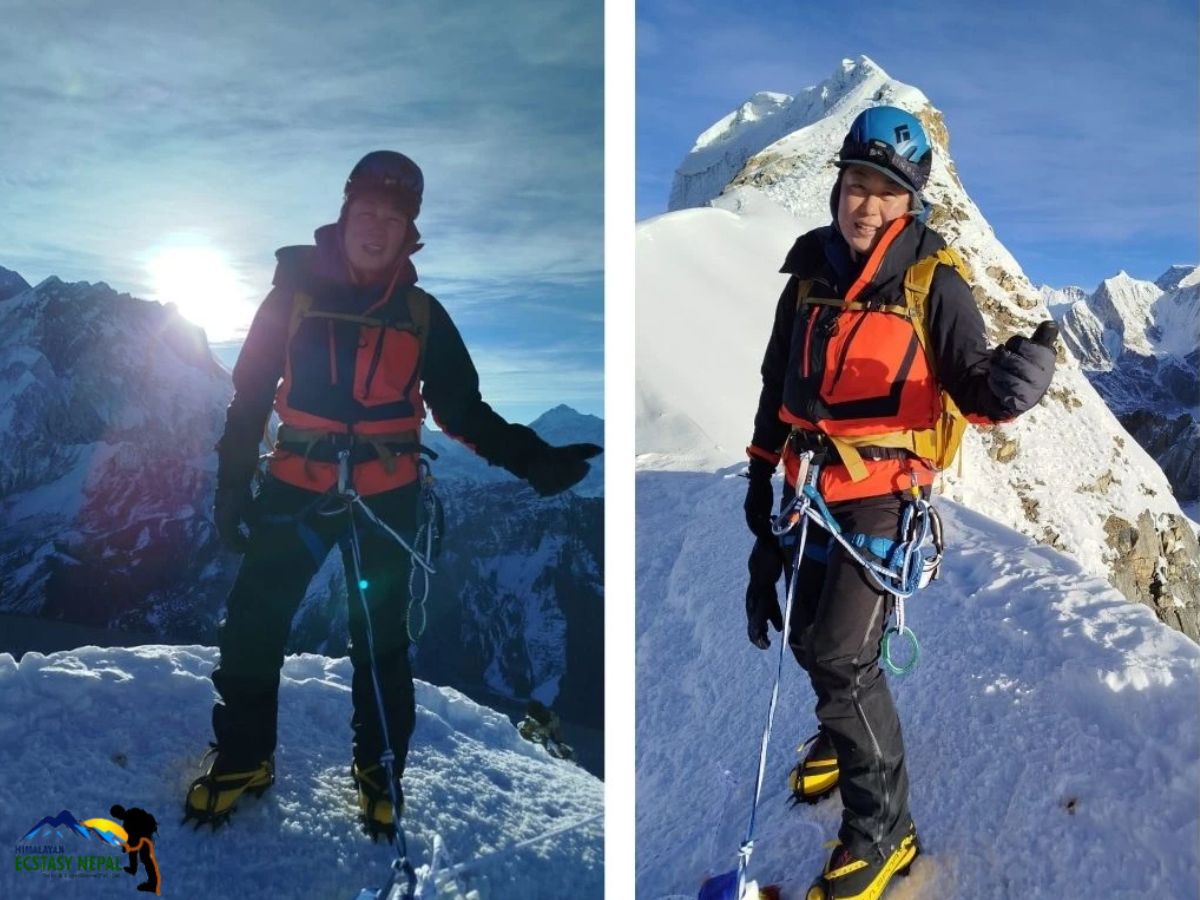
The summit day begins around 1 to 2 am with tea, a light breakfast and a final equipment check by headlamp. From High Camp, you scramble over rocky terrain to the crampon point.
The route then crosses the glacier and climbs a snow headwall of approximately 45 to 50 degrees on fixed rope, using a jumar, before reaching the exposed summit ridge.
After reaching the summit of Lobuche East (6,119 m), you enjoy panoramic views of Everest, Lhotse, Nuptse, Ama Dablam and Pumori before beginning your descent along the same route.
Your guide sets a turnaround time and monitors the weather, snow conditions and your physical condition throughout the climb. If conditions become unsafe or you are running behind schedule, the team returns to High Camp rather than pushing ahead.
After descending to High Camp, you have 2 options depending on the weather, timing and your physical condition. You can spend another night at High Camp and descend the following day, or, if conditions are favourable and the team has sufficient time and energy, continue down through Lobuche Base Camp to Pheriche (4,371 m).
The decision is always made by your climbing guide with safety as the priority. Day 8 remains available as a contingency day if bad weather prevents the summit attempt.
Max Altitude: 4,371 m or 5,400 m Meals: B, L, DAccommodation: Dome tent
Day 8 is reserved for a second Lobuche East summit attempt if bad weather or unsafe climbing conditions prevent you from reaching the summit on Day 7.
If the first attempt is unsuccessful, your team remains at High Camp, and your guide decides when conditions are suitable for another attempt. Once you successfully summit and descend, you continue toward Pheriche (4,371 m), depending on the time and trail conditions.
If you successfully summit on Day 7 and return to High Camp for the night, you can use Day 8 to descend through Lobuche Base Camp toward Pheriche. If you have already reached Pheriche on Day 7, you can continue toward Tengboche (3,860 m), following the trail through Pangboche and the surrounding pine and rhododendron forest.
If the weather also prevents a summit attempt on Day 8, additional days can be arranged at USD 120 per day beyond the original itinerary. Your guide will assess the conditions and discuss the safest available option with you.
After completing the climb, thank your crew before you part, as tips are customary. Take all your rubbish with you and continue with your own travel arrangements!
Trip Cost Details
Includes
Climbing permits for Island Peak and Lobuche East, with the paperwork processed from our Kathmandu office
Fixed rope and main rope for both climbs
Technical climbing gear: harness set with locking and non-locking carabiners, jumar (ascender), figure-8 (descender), crampons, ice screws, rock pitons, ice axe and helmet
Dome tents with mattress on a twin sharing basis at Island Peak Base Camp and Lobuche High Camp
Full camping kitchen setup at Base Camp, with kitchen and dining tents, kitchen equipment and a toilet tent
3 meals a day with a cup of tea or coffee on camping days, as shown in the itinerary
English-speaking, licensed and experienced climbing guide, with his high-altitude insurance
Assistant guides according to the group size (see the ratio in the overview)
Porters to carry climbing items to Base Camp and bring them down to the nearest town of each peak (porter ratio applies)
Insurance for the climbing guide, assistant guides and porters as required by Nepal government rules
Comprehensive medical kit with an oximeter
Pre-climb briefing, gear fitting and basic climbing training at Island Peak Base Camp
2 contingency days (Day 4 and Day 8) planned into the itinerary
Excludes
Your personal high-risk medical and rescue insurance, including helicopter evacuation (mandatory)
Your room and meals in the lodges at Chhukung, Thukla, Pheriche and Tengboche, paid directly to the lodge
Sagarmatha National Park permit and Khumbu Pasang Lhamu Rural Municipality permit (we arrange these only if you book the full arrangement from Kathmandu)
Transport to Chhukung and onward travel after the climb, including Lukla flights
International flights and Nepal visa fees
Rental of climbing boots and down jackets
Meals not listed in the itinerary and inclusions
Personal expenses such as snacks, chocolate bars, alcoholic and soft drinks, bottled water, hot showers, telephone and internet, charging and laundry
Costs from natural calamities, flight delays, mishaps or anything beyond our control
Expenses resulting from your voluntary departure or early return
Tips for guides, porters and crew (not obligatory, but expected at the end of their service)
Personal warm clothing and climbing items: mountaineering boots, sleeping bag, down jacket, trekking shoes, toiletries, sunscreen, toilet paper and hand sanitizer
Any service not specifically listed under Cost Includes
Optional services and costs that depend on your arrangements:
Private climbing Sherpa at $290 per Sherpa, including his altitude insurance, food and accommodation
Private support staff on request (additional charges apply)
Rental of warm climbing boots and down jackets, by foot size
Climbing clinic, if you sign up at least 1 month in advance
Additional contingency or climbing days beyond the original 8-day itinerary: USD 120 per day.
Full arrangement from Kathmandu (Option B), quoted separately
Essential Information
Best Time for the 2 Peak Challenge
October to November and April to May are the 2 windows we recommend!
October usually brings the steadiest weather, with clear skies, cold nights at Island Peak Base Camp and colder ones at Lobuche High Camp. November is colder and windier, with shorter days.
April and May bring warmer days, but the snow is softer and afternoon cloud is common. We do not suggest June to September because of monsoon cloud and slippery trails, and December to February is possible only if you are ready for bitter cold at both camps.
How Difficult Is This 2 Peak Challenge in Everest Region?
Strenuous, and the altitude is harder than the climbing. Both peaks are graded Alpine PD+, so crampons, fixed rope and a steep headwall are part of each summit day, with the guide supervising every step.
What wears climbers down is the combination: 2 summit days of 12 to 15 hours, 4 days apart, plus the 780 m sleeping gain on Day 6 that sits above the 500 m a day guideline.
That is why we ask you to arrive acclimatized. No technical qualification is needed, but practising crampon walking before you come gives you a head start!
Accommodation Night by Night
Experience the raw beauty of the Khumbu region as you alternate between comfortable Sherpa-run lodges and high-altitude tented camps. Here is where you will rest and recover each night of the expedition:
Day 1 and Day 3, Chhukung: a Sherpa-run lodge with basic twin rooms.
Day 2, Island Peak Base Camp: a dome tent with a mattress, twin sharing.
Day 5, Thukla: a simple lodge.
Day 6,Lobuche High Camp: A dome tent at 5,400 m, with basic facilities. Your porter carries your main duffel bag and climbing gear.
Day 7,Lobuche High Camp or Pheriche: Depending on the summit timing, weather, and your physical condition, you either spend another night at High Camp or descend to a lodge in Pheriche.
Day 8, High Camp, Pheriche or Tengboche: Accommodation depends on whether you use the contingency day and where you finish the descent.
Note that lodge rooms are unheated, and hot showers are rarely available at this height.
Food on the Trek and the Mountain
On camping days, our cook prepares fresh meals 3 times a day with a cup of tea or coffee, and on summit mornings you leave with tea and a light breakfast and carry a packed lunch and snacks.
In the lodges, the menus are short and simple, and our HEN team suggest Dal Bhat for dinner, because it is filling and the refills are free in most places.
Your appetite will drop above 5,000 m. Eat anyway, because a summit day burns far more than you will feel like replacing!
On the walk from Thukla to Lobuche High Camp, we arrange a packed lunch because there are no tea houses or lodges along the route. Carry sufficient water, chocolate or energy bars and other personal snacks in your daypack.
Your porter carries your main duffel bag and climbing gear, so you only need to carry the essentials for the day's walk.
Preparation Tips Before You Come
Getting your body and gear ready before you arrive makes all the difference when climbing two 6,000-meter peaks back-to-back. Review these essential tips to ensure you are fully prepared for the Khumbu high-altitude environment:
Break in your mountaineering boots and check that your crampons fit them before you arrive.
Talk to your doctor about acetazolamide (Diamox) well before the trip, since the right dose depends on you.
Tell your guide about even a small headache the same evening you feel it.
Practise clipping and unclipping a carabiner with liner gloves on, because fingers fumble at 5,000 m.
Carry a power bank charged in Chhukung and keep Nepali rupees for lodges and tips.
Leave a buffer day after the package before your international flight.
Transportation to Chhukung and Back
Our service starts at Chhukung, so how you reach it is part of your own plan!
Most climbers walk in on their Everest trek. If you want us to arrange it from Kathmandu, we organize the airport transfer and the flight to Lukla.
In the busy months (September to November and March to May), Lukla flights leave from Manthali in Ramechhap, a 4 to 5 hour early-morning drive from Kathmandu, so we plan around that.
Baggage on these flights is limited to about 15 kg including hand luggage, and delays are common, which is why the buffer day matters. After Tengboche, the trail continues down to Lukla for the flight back.
Equipment Lists
The 2 peaks reach 6,189 m and 6,119 m, with tented nights at 5,150 m and 5,400 m, cold windy mornings, glacier ice and long summit days. Technical climbing equipment is provided by HEN and marked below as HEN provides. Everything else is personal, and warm climbing boots and down jackets can be rented by foot size.
Head
Warm beanie or wool hat
Sun hat or cap
Buff or neck gaiter
Balaclava (recommended for summit days)
UV protection glacier sunglasses with side shields
Ski goggles for wind and snow
Headlamp with spare batteries
Upper Body
Moisture-wicking base layers (2 to 3)
Lightweight trekking shirts
Fleece jacket
Lightweight insulated jacket
Heavy down jacket (can be rented)
Waterproof and windproof shell jacket
Hands
Lightweight liner gloves
Insulated waterproof gloves
Expedition mittens for summit days
Hand warmers (optional)
Lower Body
Moisture-wicking underwear
Thermal base layer bottoms
Trekking trousers (2)
Waterproof and windproof overtrousers
Down or insulated pants for summit days
Foot Wear
Insulated mountaineering boots that fit crampons (can be rented)
Trekking boots or shoes for the trail
Camp shoes
Gaiters
Wool or synthetic socks (4 to 5 pairs)
Thick wool socks for summit days
Liner socks
Travel Documents
Valid passport and Nepal visa
Passport-size photographs
Travel and rescue insurance covering climbing up to at least 6,500 m and helicopter evacuation
Sagarmatha National Park and Khumbu Pasang Lhamu Rural Municipality permits
Copies of your passport, insurance and permits
Cash in Nepali rupees for lodges and tips
Sun Stuffs
Sunscreen (SPF 50+)
SPF lip balm
Toiletries
Toothbrush and toothpaste
Biodegradable soap
Quick-dry towel
Wet wipes and hand sanitizer
Toilet paper
Personal hygiene products
Eating & Drinking
Reusable water bottles (2 x 1 litre)
Insulated bottle covers
Insulated flask
Water purification tablets or filter
Energy bars, trail mix and chocolate for summit days
Electrolyte powder (optional)
Sleeping Bags
Four-season sleeping bag (-20°C or below)
Sleeping bag liner
Inflatable pillow (optional)
Bag Packs
Daypack of 30 to 40 litres for summit days
Duffel bag (80 to 100 litres) for your main luggage
Rain cover for the backpack
Dry bags or waterproof stuff sacks
Climbing Equipments
Harness set with locking and non-locking carabiners (HEN provides)
Jumar or ascender (HEN provides)
Figure-8 descender (HEN provides)
Crampons (HEN provides)
Ice axe (HEN provides)
Climbing helmet (HEN provides)
Fixed rope, main rope, ice screws and rock pitons (HEN provides)
Trekking poles (personal)
Medical & First Aid
Personal prescription medicines
Diamox (ask your doctor before use)
Pain relievers
Blister treatment
Bandages and adhesive tape
Antiseptic cream
Oral rehydration salts
Personal first aid kit
Miscellaneous
Camera and spare batteries
Power bank and charging cables
Universal travel adapter
Notebook and pen
Earplugs
Small repair kit
Laundry bag
Snacks for the trek
2 Peak Challenge: Lobuche Peak and Island Peak Climbing - 8 Days FAQs
Most climbers find Lobuche East the more demanding of the two, because it adds rock scrambling above Base Camp, a sustained steep headwall and an exposed summit ridge, and you start it from a higher camp. Island Peak's difficulty comes from glacier travel, crevasses and the fixed-rope headwall on a long summit day. Both are graded Alpine PD+, and that is why Island Peak comes first for beginners: it gives you the glacier and rope practice before the steeper, more exposed ground.
No. At 6,189 m and 6,119 m, climbers do not use supplemental oxygen, because both summits sit well below the altitude where it becomes necessary. What protects you is acclimatization, steady pacing and a guide who watches your oxygen saturation and symptoms. If the guide is worried about you at any point, the answer is to go down, not to add equipment.
Yes, just tell us when you enquire. We run a separate 4-day base campto summit to base camp package for Island Peak, and we can arrange Lobuche on its own in the same format. The price depends on the real number of participants in your group, so a single peak and the 2 Peak Challenge are quoted separately.
Yes, if they are in good condition and fit each other. Your boots must take your crampons, and your helmet and harness should be certified for climbing. Our guide checks everything with you on Day 1, and anything that does not pass is swapped for our gear, which we provide anyway.
Pack a headlamp with spare batteries, a water bottle in an insulated cover, a packed lunch, energy bars and chocolate, sunglasses, warm gloves and your personal medicines. Keep a spare pair of liner gloves handy for rope work. The crew carries the rest of your gear up to the camps, so your summit pack stays light.
Coverage is patchy. Lodges in Chhukung and Pheriche may sell Wi-Fi by the hour or by card and usually charge a fee per device, Thukla is more basic, and there is no network or power at Island Peak Base Camp or Lobuche High Camp. Charge your power bank and camera in Chhukung before Day 2 and treat any connection as a bonus.
A staffed altitude clinic operates seasonally at Pheriche, and Dingboche has a small health post, but above these there are no medical facilities on the trail. Our guides carry a medical kit with an oximeter and bring a sick climber down. If a helicopter evacuation is needed, we help coordinate it and the cost goes to your insurer.
They are stone cairns and chortens built in memory of climbers and Sherpas who died on Everest and nearby peaks. Many trekkers stop there for a few quiet minutes. Walk clockwise around them with the structure on your right, and do not move or take anything from them.
Chhukung Ri (5,546 m) is the classic option, a half-day hike with wide views of Lhotse, Nuptse, Ama Dablam and the Imja valley, and it is optional. A gentler choice is the walk toward Imja Tsho, the glacial lake at about 5,010 m below Island Peak, whose water level was lowered by 3.4 m in 2016 to reduce flood risk. Stay off the loose moraine edge. If you are saving energy, which I suggest, a day in the lodge's sunny dining room is a perfectly good plan.
Walk clockwise around mani walls, chortens and prayer wheels, with them on your right. Take your shoes off before entering a monastery such as Tengboche, ask before photographing monks or villagers, and do not point your feet at an altar. Dress modestly in the villages, even when the sun is strong.
Start early from Thukla and carry a packed lunch, as there are no tea houses or lodges along the route to Lobuche High Camp. Keep sufficient water, chocolate or energy bars, a headlamp, a windproof jacket and warm clothing in your daypack. Your porter carries your main duffel bag, including your climbing gear and other belongings, so you only need to carry your personal essentials for the walk.